This includes things such as catch reports, logbooks, sea sampling and port sampling information. Information on how many lobsters were caught in a particular area, the gear type used, effort, and size of the lobsters are all important in determining the status of the fishery. Better records means better information to evaluate the lobster resource.
Fishery independent means that the information is collected separate from the fishery. Biologists for the states and NMFS conduct surveys throughout the range of the lobster. The locations of the survey sampling are chosen randomly to avoid influencing the outcome of the surveys by going to areas known for good or bad lobster catches. The number and size of lobsters captured by the trawls are recorded, thereby providing information on all sizes of lobsters.
Estimation of lobster population - Knowing the abundance and mortality of lobsters is critical to determine how many lobsters can be safely harvested. Abundance, or the number of living lobsters, and the distribution of different size lobsters are important when considering the future of the lobster industry. Take for example that all lobsters harvested were within the first molt into legal size. If environmental conditions caused a bad year of recruits (animals reaching legal harvest size), the result could be a year with no new lobsters entering the fishery.
Mortality, or the number of lobsters lost each year, is broken into two categories: natural and fishing. It is important to keep track of the rate at which lobster are removed from the fishable population and the rate at which new lobsters enter the fishable population. In order to be a sustainable fishery, lobster must enter the fishery more often than they are removed.
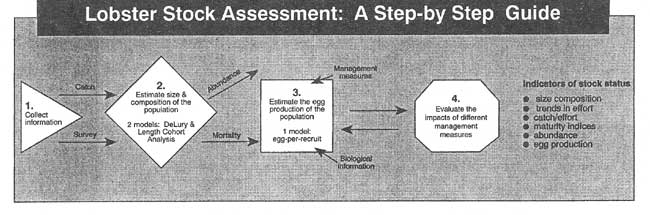
Since it's impossible to keep track of every newly hatched lobster and lobsters that die ( especially naturally), the use of models is necessary to determine how many lobsters are out there. Two models, the DeLury and the Length Cohort Analysis, are used to estimate abundance and mortality using catch and survey information. We will go into more depth of these specific models in a future article.
Estimation of lobster egg production - Egg production is an important measure of the status of the fishery. It is the basis of the overfishing definition, and therefore is the most commonly used method for evaluating the lobster fishery.
An egg-per-recruit or EPR model is used to estimate egg production. It uses abundance and mortality estimates from the previous step as well as information about the biology of lobsters and management measures. The egg production model will be discussed in further detail in a future article.
Evaluate the impact of different management options - The final step in the stock assessment process is calculating the effect of different management measures. This is the predictive portion of a stock assessment where biologists, managers, and lobstermen can ask the question, what if we did this? This step allows us to compare the outcome of different management options.
Product
A report is written by the lobster biologists, indicating the health of
the lobster stock and recommendations for maintaining or restoring the stock.
The information available from the stock assessment includes trends and estimates
of abundance, removal of lobsters by the fishery, size compositions, effort,
and amount of egg production needed to sustain the stock in the future.
This report focuses on the biology and best available information.
Managers must combine this information with the interest of fishermen (commercial
and recreational) and society as a whole (social and economic impacts) when
developing fishing regulations. Tune in to the next article to look inside
the "black box" of the lobster models.
| Reprinted from Commercial Fisheries News - November 1998 |
DeLury, LCA models
Estimating lobster mortality, abundance
|
In part four of our lobster series, Amy Schick, lobster management plan coordinator for the Atlantic States Marine Fisheries Commission, confronts the mystery of the "models.".
|
The question still stands, how many lobsters are out there? Sometimes the predictions of the scientist don't seem to match up with what you pull up in your traps. Lobstermen may be throwing back lots of undersized, oversized, and v-notched lobsters, but the scientist are saying the resource is in trouble.
One thing to keep in mind is that lobstermen know where to find lobsters from years of experience and knowledge of the fishing grounds, following the movement of lobsters onshore and offshore throughout the year. If you stop catching lobsters in one area, then you move your traps. If you pull up lots of lobsters in one area, you may move some traps into that area.
The health of the resource refers to the entire stock of lobsters throughout its range. Scientists look for changing patterns of where lobsters are caught and shifts in the sizes of the landings.
Information from the fishery is combined with survey information. Scientists choose areas to survey randomly, rather than following the movement of the lobsters. The patterns of catch in the survey are then
combined with patterns of catch in the fishery to determine the health of the resource.
Most of us can agree that we need to know the health of the resource. If the stock crashes everyone is out of the lobster business until it recovers.
An important part of the management of any species is knowledge of population size and the rate of removal of animals from the population. Knowing the abundance (the number of living lobsters) and mortality (the number of lobsters lost each year due to natural causes or the fishery) is critical to determine how many lobsters can be safely harvested.
During the stock assessment process, two models are used to estimate mortality and abundance for American lobsters: the Length Cohort Analyses (LCA) and the Modified DeLury.
Estimates of abundance and mortality are based on both fishery dependent (landings, sea sampli11g, port sampling) and fishery independent information (research surveys, biological information, tagging studies).
There are a few differences between the two models (see table previous page). The DeLury model uses the size frequency taken from surveys and number of lobsters landed in the fishery, while the LCA uses the size frequency taken from commercial fishery landings.
The DeLury model looks at the relationship between recruits (those lobsters that will molt into legal size within one year) and fully recruited (legal sized) lobsters over a number of years. On the other hand, the LCA looks at the relationship of different size groups at or above legal size within the same year
Both models provide estimates of mortality, and the DeLury estimates abundance. Finally, the LCA results are used to compare US fishery information with the Canadian lobster fishery, and to cross-check the DeLury results.
Length Cohort Analysis
The Length Cohort Analysis (LCA) model is based on the size distribution of landi11gs. The model looks at the change in the number of lobsters caught at different sizes to calculate fishing mortality.
Think of the size structure like the age structure of the human population. If you looked at how many 0-5 year old children are alive today and compare that number to how many 40-45 year olds, and even 80-85 year olds, the number of people within the specified range of ages continues to decrease. As humans get older there are fewer of us around.
The LCA works in a similar way. It may be helpful to think of the opposite of mortality, which is survival. You can look at every US census over the last 100 years to determine the survival rate. If we grouped all the people born between 1900-1910 into one category, then looked at the number of people still alive in the 1910 census, 1920 census, 1930 census, etc. we could figure out their survival rate to various ages.
Another way to calculate survival rate would be to only look at one census. Let's assume that the same number of people were born every year. (We have an idea of how many people were born in each year, but with lobster we don't have that information.) Then by looking at the 1990 census, the survival rate of people born between 1900-1910 would equal the number of people 80-90 years old divided by the number of people born in 1990. In other words, the number of people still alive after 80-90 years divided by the number of babies born.
The LCA model looks at the size distribution of a single year to determine mortality. Sea sampling and port sampling provide information on the number of lobsters caught at various sizes. This information is then broken into size ranges, similar to the age ranges in a census. Since no methods exist for aging a lobster, size ranges must be used to group lobsters of a similar age based on knowledge of growth rates.
This model utilizes only the number of legal size lobsters. The decrease in the number of lobsters from one size/age group to the next can be used to estimate age specific mortality rates. The model calculates the number of lobsters that likely die naturally (natural mortality) due to disease, predation, or natural causes and those that are removed from the population by the fishery (fishing mortality).
DeLury
The DeLury model uses information provided by surveys and catch records to determine lobster abundance and mortality. The lobster abundance refers to how many lobsters are in the water and lobster mortality refers to the total number of lobsters being caught or dying naturally each year. So the big question that follows is how can you figure out abundance and mortality from surveys and catch.
Figuring out abundance from the DeLury model can be simplified to addition and subtraction. The survey
provides a relative proportion of the number of legal lobsters, and the number of lobster that will be legal within one year. Catch provides the number of lobsters removed by fishing each year. The catch data provides away of calibrating the relative survey to true abundance. The model also considers that some portion of the population will die naturally during the year. So it follows:
|
This year's legal lobsters |
The mortality is a little more complicated. Total mortality can be estimated by looking at the new recruits and fully recruited lobsters from the previous year compared to the fully recruited lobsters this year. The idea is that if no mortality occurred, this year's fully recruited lobster should equal last year's fully recruited lobsters plus the new recruits.
To determine the mortality rate, the number of last year's new recruits and last year's full recruits are compared to this year's full recruits to determine the mortality.
|
Without Mortality Last year's new recruits With Mortality Last year's new recruits --------------------------------- |
Both the DeLury and the LCA models provide a measure of where the population is with respect to mortality rates on the fishable stocks. High rates of mortality imply rapid declines in the numbers caught at size and relatively few larger animals caught.
In the DeLury model high mortality implies a high dependence of landings on the incoming recruits.
How do scientists decide whether a mortality rate is too high? That takes us to the next step in the stock assessment process estimating the egg production of the lobster population. The use of a model of the life history of lobsters, the egg-per-recruit model, allows scientists to investigate the effect of such mortality on the expected lifetime egg production.
Tune in to the next article to look inside the "black box" of the lobster egg per recruit model.
Amy Schick
| Reprinted from Commercial Fisheries News - December1998 |
Eggs-per-recruit model
Getting to the bottom of lobster egg production
|
In part five of our lobster series, Amy Schick, lobster management plan coordinator for the Atlantic States Marine Fisheries Commission, continues her explanation of the stock assessment process. This column goes to the heart of the question: How do scientists decide the level of egg production of the lobster population? Or, what's inside the "black box" of the lobster eggs-per-recruit (EPR) model.
|
How are we going to get to 10% egg production? That's the most recent question lobstermen have been asking themselves during the Lobster Conservation Management Teams' development of recommendations to the Atlantic States Marine Fisheries Commission.
Taking a few steps back to the first article in this series (see CFN August 1998), the determination of overfishing is based on whether enough eggs are being produced to sustain the lobster stock. The overfishing level is defined as egg production - on an egg per-recruit basis - that is less than 10% of the level produced by an unfished population. Remember a recruit is a lobster that reaches legal harvest size.
How do we know when we've reached the 10%? Well, we turn to the Egg-Per-Recruit (EPR) model.
The EPR model, as with all biological models, attempts to simplify a complex system. Just because it's trying to simplify a complex system doesn't mean that the model is simple.
The model attempts to simulate the life of a group of lobsters as they grow, reproduce, and die. Many factors influence the lobster population. The EPR model is designed to consider the most influential factors in the life of a group of lobsters.
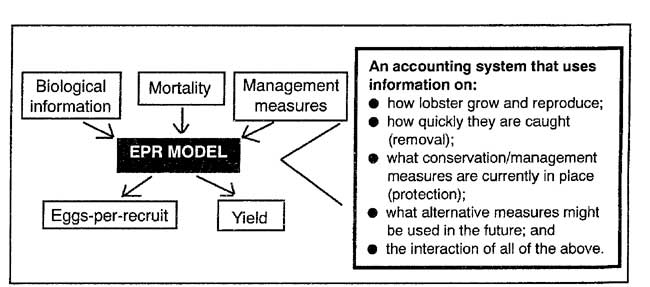
The information that goes into the EPR model comes from lobster biology, harvest rates, conservation and management measures, and possible changes to conservation measures. The model first looks at lobster growth and reproduction, then considers removals by the fishery, and finally corrects for protections on the lobster population (i.e. regulations for minimum size, etc. ).
The EPR model, like all biological models, simulates biological relationships that have been determined through years of scientific research. The relationships are expressed as a model, which is a series of mathematical equations.
The model is encoded into a computer program, serving as a framework. The model requires input data (parameters). The model processes the input data and produces a set of results.
The model's results from one set of input data are called a run. The model is run under different scenarios to determine the changes in eggs-per-recruit.
Growth, reproduction
The growth and reproduction of lobsters in the model relies primarily on lobster biology. The biological information includes size at maturity, growth rates, molting rates, how many eggs females can produce, how long they stay at the same size, and natural mortality.
The growth of a lobster is determined primarily by the frequency of molting and molt increments. The frequency of molting depends on interactions with maturity and reproduction, and is influenced by size, temperature, food, and genetics.
The model outlines a variety of categories in which a single lobster can reside at any point in time. For example, the lobsters ::an be apart of a general population, they can be Fertilized, v-notched, v-notched in previous molts, v-notched and fertilized, and double molters.
Depending on the category, the lobster can lave different levels of protection from the fishery and length of time within hat category.
The model considers four time-steps per year. The time-steps reflect what is occurring in the water seasonally with respect to he major molt, no molting, a second molt, and the release If eggs. What happens to each lobster in terms of growth and reproduction depends on the input data for the area and the time-step.
These initial runs provide an estimate of egg production from an unfished population.
Fishery removals
After considerations of growth, reproduction, and natural mortality, the model adds the effect of fishing mortality on the lobster population. The current fishing mortality is taken from the DeLury model, which was discussed in the last article (see CFN November 1998).
The DeLury uses size frequencies taken from surveys and total numbers caught in the fishery to look at the relationship between recruits (sub-Iegal) and fully recruited (legal) lobsters. The relationship of these two categories provides an estimate of fishing mortality.
Protections
Once a lobster is caught, it must meet the "keeper" criteria. Conservation measures are designed to protect specific portions of the lobster population. The current conservation measures include minimum and maximum gauge sizes, egger protection, v-notching, and escape vent size. If a lobster is too small, too large, berried, or v-notched, the lobster must be put back in the water, and therefore that lobster is not vulnerable to the fishery.
The EPR model simulates conservation and management measures. The current protections can be entered into the model, prohibiting an illegal lobster from being "caught" in the model.
The results from the removals by the fishery and protections on the lobsters provide an estimate of egg production and yield from the current fishery.
AIternative measures
The EPR model allows scientists, managers, and fishermen to predict the outcome of alternative conservation measures in the future. Alternative measures could include changes in gauge sizes, v-notch rates, and vent sizes.
Different scenarios can be put into the model to determine the egg production levels and yield under a variety of conservation measures or their combination. This predictive tool allows us to preview the possible outcomes and tradeoffs of different regulations.
Assumptions
Several assumptions must be considered when running and interpreting the EPR model results.
The first assumption is that fishing mortality has remained constant from the time of data collection. The last lobster stock assessment was conducted in 1996, and was based on fishery information from 1991-1993. Therefore if fishing mortality or effort has changed since 1991-1993, then egg production levels will change accordingly.
The second assumption is that egg production is not limited by male abundance. The EPR model only accounts for female lobsters. The model is based on egg production, and only females produce eggs. However, males must fertilize eggs. The model assumes that there will always be enough males to fertilize eggs.
Finally, the model output is only as good as the input. If invalid information is put into the model, invalid information will come out.
For this reason, thorough scientific review by the technical committee and other scientists is required to establish the best available inputs to the EPR model.
During a lobster stock assessment, a panel of scientists will review the information that is being used, and the subsequent outcomes to validate the process. An update of the lobster stock assessment will take place during the spring of 1999.
Just like accounting
Since most lobstermen know how to keep tabs on their checkbooks, comparing the EPR model to a checking/ savings account can help to explain the process.
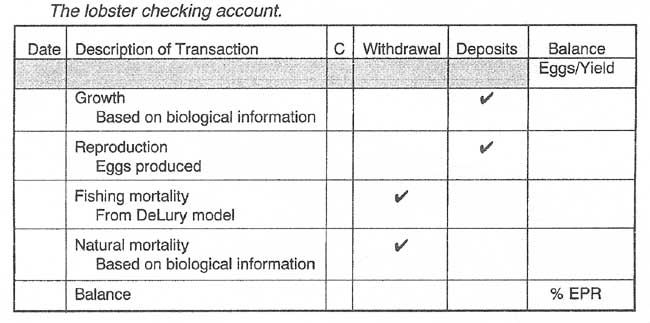
In the EPR model, lobsters can be viewed as the principal in an account. The rate at which they grow and mature creates interest in terms of increased weight and eggs for future investments.
Harvesters and the regulations determine the rate at which they are removed (fished). Rapid and early removals (high fishing effort and mortality) tend to remove more of the principal and reduce the potential for future investments ( eggs). Slower and delayed removals allow the interest to accrue, and ease the dependence on the principal itself, while future investments (eggs ) can maintain stability in the resource.
The next article will take each of the pieces explained over the last five issues and show how they all fit together to gauge the health of the lobster population and to decide the effect of management measures.
Amy Schick
| Reprinted from Commercial Fisheries News - January 1999 |
Lobster series: How the pieces fit together
|
In this final installment of our six-part lobster series, Amy Schick, lobster management plan coordinator for the Atlantic States Marine Fisheries Commission, explains how all the pieces of the puzzle fit together to complete the picture. In the August issue, when the series started, we set out to explain lobster science in plain language. The goal was to provide an understanding of the science used to gauge the health of the resource, helping lobstermen to effectively participate in the management decisions being made for their fishery. Lessons in the series have covered: the overfishing definition; the stock assessment process; the role of biological models; and the DeLury, Length Cohort Analysis, and eggs-per-recruit models. We appreciate Schick's efforts in making these Lobster Lessons possible. |
Fishery management operates under goals and objectives, targets and triggers. In the case of lobsters, the overfishing definition is based on egg production. Once the egg production, on a per recruit basis, falls below 10% of the number of eggs that would be produced from an unfished population, regulations must be set in place to increase egg production above the 10% threshold.
So when egg production falls below the overfishing level, it triggers the requirement to rebuild the lobster population.
The overfishing definition addresses the problem of when too many lobsters are caught before they can reproduce. This reduces the ability of the lobsters to replace themselves with new lobsters, which are required to sustain the fishery.
The overfishing definition attempts to reduce the risk of a fishery collapse by increasing egg production to a level that will sustain the fishery in the future.
A direct count of the number of lobsters in the ocean, or the number of eggs produced by each lobster is an impossible task. Therefore scientists turn to biological models to help answer key questions about the lobster population.
How many lobsters are out there? How many eggs are produced? How many eggs would be produced in the absence of a fishery? What is the fishing mortality? Models help to answer all of these questions.
Models attempt to simplify a complex system by using information from the past to reconstruct what is going on under the water. Models are designed to consider the most influential factors and are constrained by lobster biology. Scientists continually modify models as new information becomes available.
The results of biological models are used during a
stock assessment. The purpose of a stock assessment is to monitor the status or condition of a population.
A lobster stock assessment begins by collecting information on the lobster population and fishery - landings, effort, and fishery independent surveys. Then, the size and composition (ratio of males to females and length frequency) of the lobster population is estimated.
Two models are used to estimate fishing mortality, the DeLury and Length Cohort Analysis. The DeLury model uses the size frequency taken from fishery independent surveys and the total numbers of lobsters caught in the fishery. The model compares the number of sub-legal lobsters (recruits) to the number of legal lobsters (fully recruited).
The Length Cohort Analysis uses size frequencies taken from the commercial fishery landings. The model looks at the difference in the number of lobsters in different size groups at or above legal size. The use of two models to estimate fishing mortality allows scientists to crosscheck model outputs for accuracy.
The mortality estimates are then used to determine egg production per recruit. Once the status of the stock is determined, the eggs-per-recruit (EPR) model can then be used to determine the effect of alternative management measures.
Management decisions
So how does a stock assessment and the science translate into management? Once a stock assessment is completed, an independent panel of scientists will review the analysis. The panel will produce a report to explain the information used in the assessment, trends in the fishery, conclusions, and recommendations for management on how to maintain or rebuild the stock.
Because the overfishing definition focuses on egg production, the EPR model is often the target of discussions. However, the status of the lobster resource is determined by an assessment of many indicators, such as the size structure of the population, the ratio of males to females, trends in landings and effort, fishing mortality, and egg production.
For example, if you only check the oil in your boat, then you are very likely to break down at some point in the future. But if you check all the engine parts plus the boxes and other drivetrain components, you are less likely to find yourself stranded.
Similarly, an assessment attempts to monitor all "gauges" of the lobster population, rather than relying on a single indicator, and addressing problems when they are found to avoid being stuck in an undesirable situation in the future.
The EPR model can be used to evaluate management alternatives at any point in time. When the egg production falls below 10%, fishermen and managers must develop a method of increasing egg production. The EPR mode is a predictive model that can estimate egg production levels under various management measures.
Egg production
Currently, the egg production levels are below 10% and measures must be developed to increase egg production.
The EPR model works in the following way. For example, let's consider the option of increasing the minimum gauge size to increase egg production. Leaving lobsters in the water through one or two more molts increases the chance of females maturing and spawning prior to being caught by the fishery.
The EPR model is able to predict benefits, in terms of egg production, of this type of change in the regulations. The EPR model can also evaluate other management measures.
The EPR model is a very useful tool. Rather than spending years of trial and error in the fishery of different management measures in the fishery, which can be detrimental to the stock, the possible outcome of a management program can be predicted in a few days.
However, science is only one input into the management process. Fishery management also includes participation from the public. Public comments are encouraged throughout the process.
Fishermen can participate by attending public hearings, submitting written comments on anew fishery management plan or regulations, volunteering on panels and committees, and assisting in data collection programs.
A joint US/Canada Lobster Summit will take place March 3-4, 1999 at the Samoset Resort in Rockport, ME. The topic of the summit is "Lobster Stock Assessment: Towards greater understanding, collaboration, and improvement," and will highlight many topics discussed in this series.
Also, we have said many times over that the American lobster population was determined to be overfished during the last stock assessment in 1996. An update to the assessment will take place during the spring of 1999. I hope you are now ready to follow and be part of the stock assessment workshop dialogue.
Amy Schick