SouthernStates launches aquaculture programNorth Carolina farmers contract to grow tilapia indoors in tanks |
 |
||
|
by Rick Martin
GREENVILLE, NC - It's midsummer and the farmlands of eastern North Carolina are a sea of green. Tobacco fields are nearly ready for harvest; corn is chest high or better; and the soybean and cotton crops look promising. While this region, rich in agricultural tradition, appears to have rebounded from flood devastation that made national headlines just a year ago, there's a deeper concern rumbling among farmers here. |
 |
||
First, we have to keep our production costs low. Second, we have to have automated processing, it's critical to our success. And third, we need to be price competitive with offshore products, which we are. |
|||
|
Plummeting demand for tobacco and unpredictable commodity prices are forcing many farmers to diversify, to seek out new crops and more efficient practices. Some progressive farmers believe that an old, familiar friend Southern States Cooperative Inc. has the answer. |
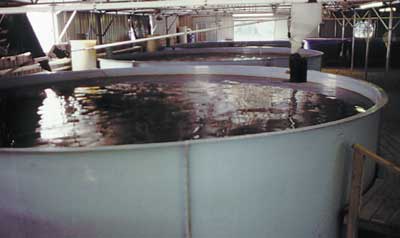
Above, interior view of a typical Southern States contract fish growout facility. A 6,000-square-foot insulated metal building houses a largely automated recirculating growout system, designed to produce roughly 200,000 pounds of market-sized tilapia each year. Experienced, established farmers who sign on to grow fish under contract to Southern States can yield a substantial supplemental farm income from their fish barn operation.
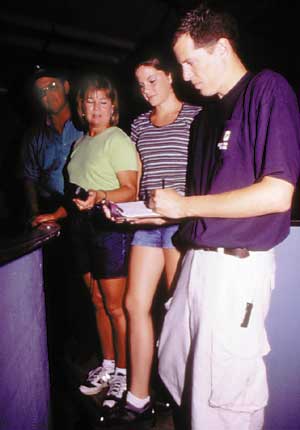
Above right, fish barn chores are a family business on the Sutton farm. Steve and Judy Sutton, from left, along with daughter Jennifer and son Jonathan (absent from photo) all help out with tending the fish system, which on average, is about a two-hour-per-day job. Southern States's regional technician, fish biologist Brian Kolarik, with clipboard, is always close by to answer questions or troubleshoot the growout system if the need arises. |
||
These farmers are among the first to sign on to Southern States's new contract growout aquaculture program. They have pledged land and labor, and made a significant capital investment to grow tilapia indoors, in tanks, under contract to Southern States.
It's a program based largely on familiar models in the hog and poultry farming industries, but one which has no real precedent in US aquaculture. The program has been received enthusiastically by farmers and is being watched with interest by aquaculture insiders.
Most in the industry agree that if this program succeeds it has the potential to quickly and significantly expand domestic aquaculture production and to reshape conventional thinking regarding fish farming in recirculating systems.
Who is Southern States?
Founded in 1923 by 150 Virginia farmers, Southern States Cooperative today is a diversified organization active in 26 states and owned by more than 300,000 farmer members. The co-op, which is based in Richmond, VA, employees 5,500 people and has annual sales in excess of $1.6 billion.
Some fish farmers may know the Southern States name from the co-op's aquaculture feed division with mills throughout the Southeast.
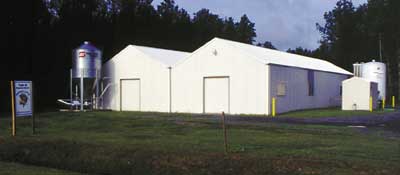 |
Left, an exterior view of the Triple M fish barn. A bulk feed hopper, left, serves an automated feed delivery system inside and liquid oxygen tanks serve each of the barn's fish tanks via a computerized monitoring and control system. | ||
But for many in the aquaculture community, the first exposure to Southern States is through Brian Squyars, director of Farmer's Catch, a division of Southern States, and the co-op's point man in aquaculture.
Squyars, a former fish farmer and fishmonger with a strong background in retailing and merchandising, has been actively involved with the US tilapia and seafood industries for the past several years.
The confident, sometimes intense Squyars is completing a three-year term as president of the American Tilapia Association (ATA) and chairs the National Fisheries Institute's (NFI) National Aquaculture Council.
|
|
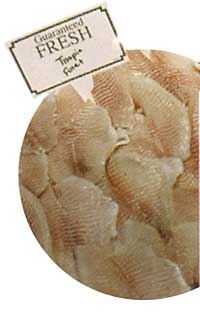
Southern States plans to market the bulk of its tilapia production as fresh, processed product under the Farmer's Catch brand name. Automated processing, top quality product, and cost-effective production are crucial as Farmer's Catch becomes the first processed US brand to compete aggressively with foreign imports that now dominate the market. |
Though visible through his involvement with industry groups and activities, Squyars has, until now, been fairly tight-lipped about Southern States's aquaculture plans.
In this part of the country, Southern States is synonymous with farm supplies. The co-op provides farmers with feed and seed, fertilizer, fuel, and farm chemicals. It helps farmers market their grain and livestock and can help with farm-financing needs. Building on its large base of farm supply stores, Southern States has also become a major player in the retail home and garden store business.
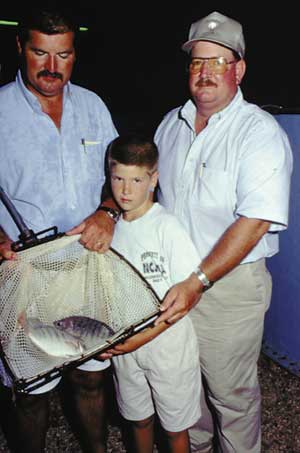 |
Brothers Johnny, right, and Shea McLawhorn, with Shea's son Mason, show off tilapia nearing market size from the family's Triple M Aquaculture farm near Greenville, NC. . It is abundantly clear when talking to farmers participating in the new aquaculture growout program that their confidence in and familiarity with Southern States were major factors in helping Squyars recruit early subscribers to the new venture. As one aquaculture veteran observed, "Southern States has so much riding on its reputation with these farmers, they almost have to make this program work ... and the farmers know it." |
|
Growout program
"Tobacco farmers in this part of the country are suffering. Some have lost as much as 36% of their tobacco-related farm income," Squyars pointed out while driving through rural Pitt and Washington counties of North Carolina.
Southern States is offering these farmers the chance to grow another cash crop: tilapia now, and other species under development.
Farmers who participate in the program agree to buy a turnkey system from Southern States for an initial investment of about $375,000, which the co-op will finance, and provide five acres of land.
For his investment, the farmer gets a 6,000 square-foot insulated building and a ready-to-run, largely automated recirculating growout system. The barns and growout systems are all identical, designed and built to Southern States's specifications, by the co-op's own contractors.
Once the fish barn is up and running, the farmer agrees to provide labor and utilities. Southern States provides the feed, fuel, and technical support.
Southern States also provides the fish fingerlings which they have raised in their own nursery from hatchery-supplied fry and guarantees a market for the fish at the end of the growout cycle.
"We take the marketing headache out of the equation," Squyars said.
"Southern States owns the fish. The farmer participates under contract to provide market-size fish and gets a portion of the farmgate price when the fish are harvested and sold. If he has financed his building through us, we deduct his mortgage payment and send him the balance," Squyars explained.
Each system is designed to produce roughly 200,000 pounds of market-sized tilapia annually, with growout staggered to allow year-round harvest. Or, farmers can opt for a larger system, Squyars said, which is designed to produce about 400,000 pounds of production annually and can be loaded to provide a harvest every month.
The program is still in its infancy, with the first real volume of fish now starting to hit market size. Neither Squyars nor the participating farmers wanted to discuss specific financial details of the program, but all said they were satisfied thus far. One farmer said the returns appear to be comparable to those from his chicken barn, while requiring less labor and less space.
Farmers
The landscape outside of Greenville in rural Pitt County is dotted with family farms some big, some not so big but many being worked by the third, fourth, or fifth generation of family members to till this black, fertile land.
It's here that Southern States has launched its aquaculture program with farmers such as brothers Johnny and Shea McLawhorn and a few miles down the road, Steve Sutton.
These are multigenerational family farms, whose owners are looking toward the future. They know row crop farming tobacco, cotton, corn, grain, and soybeans and they know the rigors and risks of raising livestock hogs, poultry, and cattle.
They believe in Southern States and, while it's still very early in the evolution of the aquaculture program, believe growing fish indoors under contract could be the "next big thing" for local farmers, providing a new cash crop with a promising future.
Fish farming isn't totally new to this region. Shea McLawhorn said his neighbor "tried growing catfish in ponds a few years ago and didn't have a very good experience.
"We like the enclosed building a lot better, the controlled environment," he explained.
Most of all though, the McLawhorn brothers and Sutton agreed, it's the limited farm labor requirements about two hours a day on average that make the Southern States fish program appealing.
"This is one of the few things we've gotten into that's actually taken less time than we were informed when we started," Johnny McLawhorn said.
Generally speaking, the farmers said the fish barn runs like any other animal barn, but smells better. They service the fish barn as part of morning "chores" every day, then look in on the system checking the monitoring/control screen on the computer several times throughout the day and last thing in the evening.
The automated system is programmed with a range of alarms that trip a pager which alerts the farmer day or night. The tilapia, like dairy cows, require an around-the-clock, seven-days-a-week commitment from the farmer, not intimidating to these farmers.
"We're already confined with our chicken house, and four months out of the year I'm confined with a greenhouse growing tobacco plants. I don't go a whole lot, neither does my wife," Sutton said.
The McLawhorns and Sutton cautioned though, that as automated and reliable as the fish system is, when alarms go off and they do the farmer has to respond quickly and deal with the problem.
"I was completely fish illiterate when I signed onto this program," Sutton said. "But you know, this is not so much a place to grow fish as it is a place to treat water. This thing is elaborate, but it's simple enough that the farmer can, through education, learn the system and do what it takes to keep it up and running.
"I think it offers as much potential as growing hogs or chickens in a building. I said to myself, 'Steve, you're doing the same thing here that Frank Perdue did several years ago with chickens.'"
 |
The McLawhorns already have a pad in for possible expansion either a hydroponics system and/or another fish barn. Sutton is equally committed. "I haven't even sold a fish yet and I've already started a second building." "Hub" conceptOne of the cornerstones of the Southern States program is the creation of contract farming hubs in close proximity to major markets. It's efficient and provides good management control, Squyars said. |
|
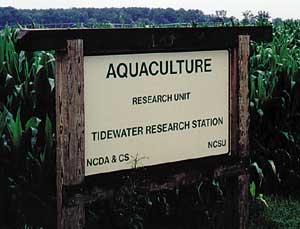
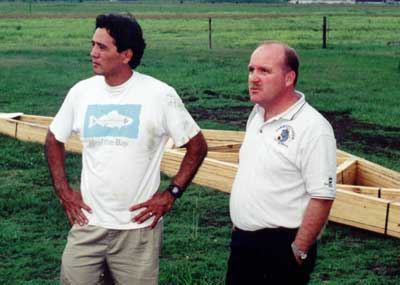
Southern States's Brian Squyars, right, with Dr. Harry Daniels outside North Carolina State University's Tidewater Research Station, where Daniels is studying the hatchery techniques needed to produce southern flounder commercially. Southern States is providing significant support toward this research in hopes of adding southern flounder to its contract growout program within the next few years |
 |
Each hub, he explained, will consist of several contract growout facilities, served by a Southern States nursery to provide fingerlings, a Southern States feed mill, a Southern States technical support representative, and a Southern States fish processing plant all within easy driving distance.
The hub concept is already being applied in eastern North Carolina where Squyars has three contract farms on line, two more under construction, and several additional subscribers lined up for fall construction, plus expansion plans in development with some of the "first wave" farms.
The hub is served by a Southern States aquaculture feed mill in Farmville, NC and a Southern States fingerling nursery in southeastern Virginia. Technical support is provided by Southern States's fish biologist and systems technician, based in Greenville, NC.
In early August, plans were also being finalized toward opening Southern States's first fish processing plant in Plymouth, NC, which will complete the first hub.
Squyars said he is replicating the hub concept again in southern Georgia, near a feed mill in Valdosta, where "the equivalent" of 10 new contract farms have just begun construction.
Short-term plans, Squyars said, are to "get 25-26 contract units on line pretty quickly. That would deliver us about 5-1/2 million pounds of production (live weight)."
By comparison, total domestic tilapia production from all US farms is currently about 18 million pounds annually.
Although some farmers would like to have three or four fish barns ultimately, Squyars said his current philosophy is no more than two systems at any one location. "I'd rather have many farmers out there, each with limited liability, rather than have a lot of fish in any one location. The same thing applies to our fingerling nursery operation."
After a slow and cautious beginning, the Southern States aquaculture program is clearly taking off. Southern States spent more than three years developing the program and testing the system components in fish growout trials at its own facility in Providence Forge, VA, and the program was only rolled out to farmers just over a year ago.
New subscribers are signing on about as quickly as Squyars can handle them and the program received a significant boost with the recent announcement of additional financing through a government loan program.
In early July, Southern States announced that the co-op had been approved for a $10 million loan from the Department of Commerce, through its NOAA/NMFS Fisheries Finance Program, an initiative designed to help take pressure off wild harvest fisheries.
The loan is strictly earmarked for aquaculture development through Southern States, Squyars said. The co-op will use most of the money to help farmers in the aquaculture program finance systems, he said, and the balance will be used by the cooperative for construction of an additional fingerling nursery and to develop its processing plant.
Currently, the program is only available to farmers on a limited basis in southeastern Virginia, northeastern North Carolina, and in the immediate Valdosta, GA area, Squyars said.
Standardized systems
While the Southern States contract farm program is a work in progress, subject to some inevitable tweaking as it goes along, Squyars is a fierce proponent of standardization, consistency, and the use of single-source, proven vendors whenever possible.
He applies this rule to his fish all tilapia fry are hatchery-reared nilotica from Mike Picchietti's Aquasafra Inc. in Bradenton, FL.
"I buy them (fry) all from Picchietti. We get them at between 1/2 to one gram in size, and stock them (to the farms) at 50-80 grams, a 5 to 6-inch fingerling," Squyars said. "We like Aquasafra fish, period. They are high quality, healthy; his facility has never tested positive for strep. I won't jeopardize this program by bringing in and mixing other fish."
The same rule applies to the growout systems.
Each system consists of 24'-diameter Gemini fiberglass tanks with an automated recirculating water handling system designed in cooperation with Water Management Technologies Inc. (WMT) of Baton Rouge, LA (see Industry Profile, pages 30-31).
The standard package from WMT includes Hydrotech drum filters, Pacific Ozone ozone generators, motor and computer control systems, and other prefabricated water treatment components.
Exact system particulars are not something Southern States wishes to disclose, but the basic design employs elements and features that WMT's Terry McCarthy and Glenn Snapp developed during past experience in other settings.
"It's not that we're trying to hide any secrets, but we have made a significant commitment to our farmers and a considerable investment in developing these systems," Squyars said.
"Understanding how to manage fish through the system, and a sound marketing strategy are really the keys to succeeding in aquaculture."
Water use requirements are limited in the system; daily make-up is about 2%, or 2,500 gallons of fresh water not a significant draw by most agricultural standards, farmers said.
Each farm is served by its own well or wells, with water coming into the system at about 65° from the well head. Propane, from Southern States, is used to heat the inflow, bringing system water up to 84°, the optimal temperature for nilotica growout.
Waste from the facility is either routed to a modified septic system or to a retention pond. In either case, solids are captured and can be dried and spread as fertilizer by the farmer; water from the pond can be reused for irrigation. Automated feeding to each tank in the system is accomplished by a Cablevey system, drawing from bulk feed hoppers outside the building, and controlled through the farm's management and monitoring software system.
Feeding cycles can range from two or three times daily early on, to 12 daily intervals at peak, dropping back to six feedings nearing maturity. Fish are sampled every three weeks and the automated feeding flow adjusted accordingly for maximum efficiency.
Fish are fed a Southern States protein-rich tilapia diet and reach 1-1/2 to 2 pound market size at between five and six months of growout, Squyars said.
Squyars described the Southern States system as complex enough to effectively and efficiently grow fish, robust and reliable enough to stand up in an agricultural environment, and simple enough for farmers to operate, maintain, and troubleshoot with limited labor and training.
Labor reduction is central to system and facility design, including fingerling delivery and harvesting methods. Southern States has its own live haul truck, equipped with a lift-bed (like the trucks that service planes at airports) that allows a single driver/operator to open a valve and load a tank with fingerlings in about 10 minutes.
At harvest time, the farmer takes one tank off line for three days to purge the fish, then in preparation for harvest, drains the tank to about knee deep.
Fish are currently seined and hand-loaded into the live haul truck, an operation that will soon be more automated, according to Squyars. "We're developing a conveyor with a hopper at one end that will set down into the tank. We'll seine the fish into the hopper, then move them by conveyor into the truck. Less labor and easy on the fish," Squyars said.
Fish are then graded by size at the processing plant.
Marketing key
While farmers are the backbone of Southern States's aquaculture program, product marketing will be the critical element in achieving financial success.
"I think there's a misconception that our program is going to bring a lot of fish onto the live market and hurt other tilapia growers," Squyars said. "Yes, we'll sell some live fish, but overall, our production will go into the market as a processed product."
It is this strategy that raises the most questions within the traditional aquaculture community. The market for processed tilapia in this country is dominated by foreign imports, from growers who historically have had much lower production and processing costs than their American counterparts. Can Southern States compete with these imports and still show a profit?
Squyars says absolutely, "Yes."
"Until now, American producers really haven't been competitive in the processed tilapia market. Our economies of scale enable us to compete.
"First, we have to keep our production costs low. Second, we have to have automated processing, it's critical to our success. And third, we need to be price competitive with offshore products, which we are."
Southern States has been working with a leading manufacturer of fish processing machinery to develop automated tilapia processing machinery for use in its plants. Although Squyars said it is impossible to completely eliminate hand trimming, especially at the end of the processing line, he believes their automated system will drastically reduce the labor costs traditionally associated with processing tilapia.
"We think we can get labor down to where it's comparable to the US catfish industry," Squyars said. "Also, we will recover protein from what is now thrown away as waste, as well as market value-added tilapia products."
"For fillet yields, we're looking to improve the traditional 31-1/2% to 32% yield. Although customer requirements vary, the retail market for fresh tilapia generally wants a 5 to 7 ounce fillet," Squyars said.
Southern States plans to market its product under the co-op's Farmer's Catch brand name, and garner a premium based on quality and brand identity. Squyars said he has a letter of commitment from a major East Coast seafood distributor to take virtually all of his production for the next several months, at a pre-agreed premium price.
"We went through three product evaluations in their test kitchens. Our product samples came out on top of some very good quality imports and we reache
|
A key element of the Southern States contract fish growout program is the creation of regional "hubs" as illustrated on the next page. Each hub, comprised of several contract farms, will be served by a Southern States fingerling nursery, feed mill, and technical rep. Production from the hub will be routed to a single, centralized Southern States fish processing plant before shipping to market. Ideally, each hub will be adjacent to a major metropolitan market, cutting down on transportation time and cost.
|
d an agreement. They believe they can move this product at a profit and meet our price point.
"Wholesalers and retailers have voiced concerns over inconsistent quality with some imported product," Squyars said. "We can provide high quality and extended shelf life by being closer to the market.
"Fresh tilapia fillets at $5.99 a pound (retail) offer a fantastic value to the consumer. Tilapia is not going to be at the high end nor the low end of the product in the seafood case; it has a nice niche right in the middle. I think you'll find tilapia has a secure place in the market at $4.99-$6.99; it's there now and I think it will stay there."
Looking ahead
If the Southern States aquaculture program is successful it will help the co-op's traditional core customers diversify with a new cash crop, provide added demand for co-op services and products like feed and fuel, and establish a brand identity with the Farmer's Catch name that could lead to an additional business unit for the co-op.
Plans on the table right now include growing the network of participating farmers and investigating the viability of moving into other species.
"When we first looked at this, we had a 10-year plan of 100 units. We'll probably have 100 systems on line within five years," Squyars said, "But they won't all be tilapia."
Southern States is working closely with Dr. Harry Daniels at the North Carolina State University's Tidewater Research Station, near Plymouth. There, with significant support from Southern States, Daniels is studying the hatchery techniques needed to produce southern flounder commercially. Southern States is developing the culturing requirements.
Squyars said the work thus far points very favorably toward southern flounder being the next species in the Southern States growout program. One of the species' significant advantages is that although they are a saltwater fish they can be cultured in fresh water, and seem to do well in tanks.
"Southern flounder are a generally healthy, hardy fish," Daniels said. "They can take all kinds of salinity and we know they can withstand really high temperatures."
Construction is currently underway on a Southern States-funded commercial-scale fingerling nursery, expanding Daniels's existing hatchery. The goal is to produce about 100,000 fingerlings annually, beginning next spring. Once commercial growout trials are completed, Southern States hopes to start loading some farm systems for southern flounder production within the next 18-24 months.
Other species could follow.
"I believe our system and approach can be adapted and expanded to a variety of species as we go along," Squyars said.
"We're going to focus our research and development not on system technology, but on new species and how those species interact with our technology. We will be market driven every step of the way."
