Hematology and plasma chemistry
More tools to monitor fish stock health status
|
ITHACA, NY - If you or your animal is sick, one of the first things a health professional does is to take a blood sample. By comparing the various components in the blood with standards established in healthy individuals during careful baseline studies, a clinician can often tell you what's wrong. The great thing about this kind of diagnostic testing is that it isn't necessary to kill you or your animals to do it. Of course, there is a limit to the size of fish you can nonlethally sample, but most production-size stock can be easily bled. |
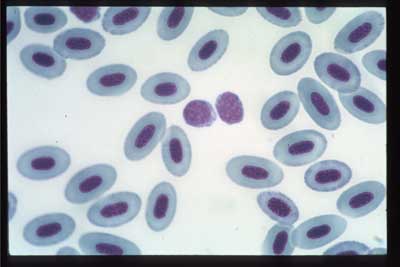 |
| Nucleated fish red blood cells surrounding two lympocytes stained with Giemsa. |
For the past year, the Cornell University Aquatic Animal Health Program has been working with a local tilapia grower to establish baseline values for a number of parameters in tilapia blood.
We're not the only group in this line of research. The veterinarians at Virginia Polytechnic Institute and State University, including Drs. Terry Hrubec, Jenifer Cardinale, and Steven Smith, recently published an article in Veterinary Clinical Pathology. They compared the reference values for blood from tilapia that were held at low and high (production) densities.
In this column, I will go over some of the possible diagnostic interpretations we can make from hematological (blood) information. But first some background on blood, plasma chemistry, and those kinds of things is in order.
Blood
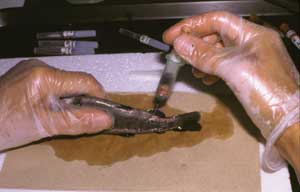
Sample blood is usually collected with a needle and syringe or a similar device called a Vacutainer tube (see photo at right). The blood ends up in tubes containing an anticoagulant such as lithium heparin so it won't clot.
For the hematology part of this testing, you want to look at the cellular portion of the blood the red and white cells. Total counts of the red and white blood cells can also be done in a counting chamber placed under a microscope.
Differential counts are done on white blood cells because there are more then one kind. Usually a drop of blood is smeared on a glass slide, dried, and then stained so that you can tell the different types of white cells apart. A trained eye can distinguish small lymphocytes, large lymphocytes, neutrophils, monocytes, eosinophils, and thrombocyte-like cells (see photo).
 |
If you spin a small drop of the blood in a very thin tube, you can find the packed cell volume (PCV), which is also called the hematocrit value. The amount of hemoglobin in the fish's blood is measured in a spectrophotometer in a simple chemical assay. PlasmaYou can also spin these blood tubes in a centrifuge so that the cells will sink to the bottom, leaving the plasma on top. It's this liquid portion of the blood that we want to analyze for its chemical components. There are different ions in plasma like chloride, calcium, and ammonia, as well as proteins, lipids, and a variety of enzymes. |
| Bleeding a young salmonid with a Vacutainer tube. |
There are automated systems to measure all these different blood chemistries. Those labs without the fancy analytical machines can conduct the biochemical assays at the bench. It may be the old-fashioned way, but it still works.
Reference values
Blood parameters are only meaningful if you know the normal values for the species you are rearing. There is a National Committee for Clinical Laboratory Standards that has recommended procedures for developing these values or intervals. Though I won't go into them here, they are a critical part of making this effort worthwhile.
So, why are we doing all this work here at Cornell, when researchers in Virginia have recently published reference values for tilapia? Because the culture conditions and environmental variables at a specific aquaculture facility can markedly affect the values of these different blood parameters.
Other reasons why reference intervals may vary include how the sample is taken and subsequently handled, as well as a low sample number. The number of individuals tested to create reference values should be at least 30 to 40 fish from the same population.
Also, allowing the blood to clot and testing the serum will give you different values than testing plasma, which still contains the clotting factors. Tubes of heparinized (unclotted) blood should always be kept on ice to maintain the stability of the blood components until the plasma is separated by centrifugation and frozen prior to analysis.
When the Virginia group compared reference intervals between high density (production) and low density tilapia, they found significant differences.
So, the bottom line is this: Since reference values are not yet routinely used in the fish diagnostic world and there is some variability between sites and species anyway, it's a good idea to start with baseline data from your own farm in the first place.
Examples
I'd now like to give you several examples of how measuring hematological and biochemical values in fish blood could be used as a diagnostic tool.
The first study by Hrubec et al. looked at whether high ammonia or nitrate concentrations sometimes found in production systems cause blood values to be outside their normal reference intervals. It's important to know whether poor water quality can cause changes in blood chemistry if you want to tell the difference between the stress of poor water conditions vs. an approaching disease problem.
These investigators found that 0.15 milligrams of ammonia per liter (mg/L) did not significantly effect any of the blood analytes, but that 200 mg/L of nitrate lowered the concentration of chloride ions and increased the level of creatine in the blood.
Researchers at North Carolina State University have demonstrated that the repeated handling and confinement of striped bass cause alterations in their plasma chemistry such that osmolality decreases, the levels of sodium and chloride are reduced, and cortisol and total carbon dioxide are increased. The lysis of red blood cells that was clearly visible in the plasma, as well as the obvious red belly and tail fin, were other signs that the handling of these fish was causing stress-induced changes to the osmoregulatory system, which is how the fish controls its fluid and salts.
A study of rainbow trout with Proliferative Kidney Disease (PKD) showed changes in the blood picture as the disease progressed and greater damage occurred in the kidney.
Compared to the control trout, packed cell volume (percentage of red cells), hemoglobin values, and red cell counts continued to decrease as the disease worsened. Significant decreases in the number of white blood cells also started early in the PKD infection.
The exception was the increase in the percentage of neutrophils (also called heterophils) that appeared as the disease progressed and the kidney began to swell. Other infectious diseases and stressful conditions have also been shown to elevate the numbers of heterophils.
Other workers have considered whether the level of lipid components in the blood plasma are good indicators of disease resistance. They have shown that the higher the cholesterol and phospholipid levels in rainbow trout and Japanese yellowtail blood, the greater the chance of surviving a challenge with a bacterial pathogen.
There are even studies that have looked at the effect of aquatic herbicides on blood parameters. The stress that these chemicals may induce can effect both the respiratory (gills) and circulatory (blood) systems of the fish. Depending upon the chemical tested, the effects on the plasma chemistry can be significant.
Prevention best
In my last column, I tried to show you why the newest diagnostic kits may be worth a look (see FFN May/June 2000). In this issue, I've tried to convince you that nonlethal blood samples analyzed on a regular basis may provide an early warning system for conditions that subtly affect production numbers or infectious disease outbreaks.
The more blood and plasma studies that compare healthy fish to fish with specific diseases or environmental stressors, the more valuable this diagnostic method will become. It's just one more preventative approach that fish farmers can adopt to enhance their operations.
Rod Getchell works in the Aquatic Animal Health Program at the Cornell University College of Veterinary Medicine.

Please contact
Fish Farming News for reprint information
and permission. - © Compass Publications, Inc.,
2000