Diagnostic kits:
Tools for growers to monitor stock health
ITHACA, NY - Diagnosing fish and shellfish diseases is never an easy job. The time and expense needed to monitor your aquaculture stocks invariably leads to putting it off, but not knowing what kind of pathogens may be coming in the door or going out on the next truck can hurt your business.
|
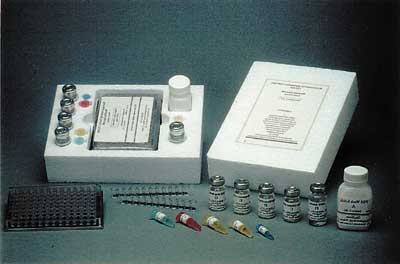
Nowadays, aquaculture producers can use commercially available diagnostic kits as a tool to monitor for the presence of pathogens in their animals. As shown by the above example from DiagXotics, the test kits come complete. Whether using DNA-based or ELISA technology, the DiagXotics kits are easy to use and provide fast results. |
A solution to this dilemma for a few major species is the use of diagnostic kits that can detect many of the significant pathogens out there. Taking advantage of the most sensitive and specific products available helps both you and your fish health specialist to make the right management decisions.
Advances in molecular techniques and the improvement in the quality of diagnostic reagents have led to the development of detection systems for shrimp pathogens and shellfish biotoxins, as well as for salmon and catfish agents.
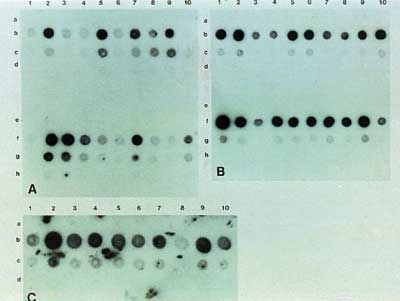
| Right is an example of the dot-blot assay from the ShrimProbeTM.
|
 |
Understanding a little about how these test kits work will help you interpret the results and hopefully demonstrate the value of this type of preventative approach.
Penaeid shrimp
Just because these kits are easy to use doesn't mean the technology behind their construction is simple.
Let's take the new ShrimProbeTM from DiagXoticsTM as an example and explain what is really happening in critical steps of the protocol. Those of you who read my column on DNA vaccines may recognize some of the terms (see FFN November/December 1999).
The ShrimProbeTM kits can be used to detect all of the major viruses infecting Penaeid shrimp. The main component of these kits is a specific DNA probe that consists of an exact copy of a portion of the shrimp virus' genetic code.
These long strings of nucleic acids (the NA in DNA) are usually found in pairs. But, if you heat them, say in boiling water, the strands of DNA will separate. So, one of the first steps in the ShrimProbeTM protocol is to boil your sample of shrimp tissue for 10 minutes and then add a drop of the boiled tissue to a special membrane that is then baked at 65°C for 30 minutes.
This heating process keeps the strands of DNA separated and permanently attached to the membrane. You also boil the probe and then incubate this with the membrane for three hours. If the tissue you are testing contains the virus you are looking for, the ShrimProbeTM will bind to the DNA of the pathogen.
How exactly do you know if your probe has bound to its long lost "DNA brother?"
Well, attached to the probe is a chemical called digoxigenin (DIG), which is called a reporter molecule. After the unbound probes are washed away, you add anti-DIG antibodies that bind to the DIG, that's attached to the probe, that's locked to the DNA in the infected tissue sample. It's kind of like making a big sandwich!
And there is one more step. Attached to the anti-DIG antibody is an enzyme called alkaline phosphatase. When you add the substrate for this enzyme, it creates a dark spot on the membrane where you first placed the shrimp tissue. Of course this only occurs if there was any virus that the probe could bind to in the first place.
Fast turn-around
DiagXotics provides strong positives, weak positives, and negative control membranes so that you can accurately interpret the results of your test.
So, in the space of a single workday, you get to know if your stocks are infected or not. You don't have to wait weeks for the isolation and identification of the viral pathogen.
Routine monitoring now becomes more appealing because you get the results back fast and, therefore, prevent the further spread of any problems. You can also use these tests to screen your broodstock for specific pathogens and avoid transmitting a pathogen from the parents to the offspring.
The shrimp farming industry has set the development of specific pathogen free stocks as one of its highest priorities.
If you want to see a more detailed explanation of what's going on in this dot blot assay, go to DiagXotics' web site at <http://www.diagxotics.com/dotroub.html>.
ELISA
A second kind of test kit utilizes monoclonal antibodies instead of these fancy DNA probes.
What's a monoclonal antibody? Monoclonal antibodies are highly specific immune reagents and are usually prepared in mice. In other words, when a monoclonal antibody binds to a pathogen, it is confident it has caught the "perpetrator." The likelihood that you'll have a cross-reaction and therefore a false positive result is a lot less with monoclonal antibodies.
The diagnostic tests that take advantage of these specific monoclonal antibodies are often Enzyme Linked ImmunoSorbent Assays (ELISA).
|
There are loads of human and veterinary diagnostic tests that use this ELISA technique. In all of these, you can get a quick idea of whether the population you are testing is currently infected. The list of fish pathogens that you can check for, both bacterial and viral, continues to grow as the markets develop for these test kits. The Furun-Kit® is one such ELISA produced by DiagXotics that detects the causative agent for furunculosis (Aeromonas salmonicida). Let's take a look at how it works. The test is performed in a 96-well plastic plate. Each of the wells is almost big enough to hold a 22-caliber slug. The wells in this example are coated with the monoclonal antibody to A. salmonicida.
As the drawing shows, ELISA Enzyme Linked ImmunoSorbent Assays takes advantage of specific monoclonal antibodies to determine the presence of pathogens. |
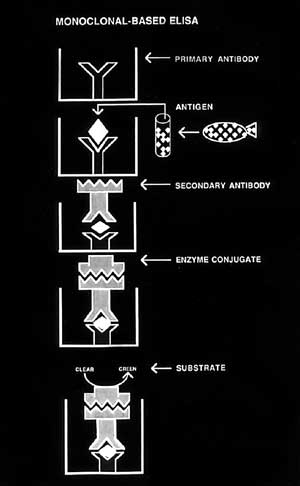 |
The tissue samples or blood to be tested are added to the wells along with some negative and positive controls that are used for comparison at the end of the assay. If any of the samples contain the furunculosis bacteria, it is grabbed or "captured" by the monoclonal antibody coating the wells. The unbound material is then washed away.
You follow this up with more monoclonal antibodies to A. salmonicida, but this antibody has an enzyme attached to it. If there are no captured bacteria, then the monoclonal antibody has nothing to bind to and is removed in the wash step. But, in a positive sample, a great deal of this enzyme-laden monoclonal antibody will bind to the trapped bacteria.
The next part is similar to what we did in the dot blot assay. You add a substrate for the enzyme, which reacts and causes a color change that can be measured in the laboratory. A similar KwiK-Furun-Kit can be run in test tubes right at your farm.
For those sample wells that show no color change, a diagnosis of "uninfected" is easily made. The degree of color change in the positive wells is proportional to the amount of A. salmonicida in the infected tissues. So, the ELISA can actually tell you the relative intensity of infection in the tissue you are testing. And all this can be done in a little over one hour.
PSP
The third kit I'd like to mention is a rapid diagnostic test for Paralytic Shellfish Poisoning (PSP). Jellet Biotek has developed the MISTTM Bioassay for PSP, which is the first commercially available system that can screen for marine biotoxins.
Shellfish growers and processors may now be able to ensure their product is free of toxins without using the more traditional mouse bioassay.
The PSP toxins can be measured in extracts from many different types of samples, including shellfish, water samples, phytoplankton cultures, and lobster hepatopancreas.
The MISTTM bioassay uses mouse neuroblastoma cells in tissue culture and detects sodium channel activity. Many marine biotoxins like PSP block the sodium channels in cells and thereby cause their devastating effects.
Jellet Biotek has also developed the MIST AlertTM test that lets you know in 20 minutes whether PSP toxins are present. They plan to make these kits commercially available by the summer of 2001.
Test it yourself
There are more diagnostic tests out there than this of course, but you get the idea.
When it comes to test kits, the aquaculture industry is catching up with other agricultural businesses like poultry and cattle. Only by trying these easy-to-use kits will you be able to tell for yourself whether the diagnoses are accurate, the results cost effective, and the effort worthwhile.
Rod Getchell works in the Aquatic Animal Health Program at the Cornell University College of Veterinary Medicine.

Please contact
Fish Farming News for reprint information
and permission. - © Compass Publications, Inc.,
2000