Scallop diseases: Much to learn
ITHACA, NY - Scallops have been a late entrant on the shellfish farming scene, and so has scallop disease research. Our knowledge of why scallops die has lagged behind the progress made in other species of shellfish such as oysters, mussels, and clams.
Scientific papers from the 1950s and '60s discuss mass mortalities of scallops that occurred in the wild, but often failed to identify the pathogen or parasite involved. Those diseases and parasites that were known at that time only had slight effects on their scallop hosts.
Today, most scallop disease research is being done at government and university research laboratories, and not during routine diagnostic work.
As scientists and aquaculturists have brought different species of scallops into their labs or onto their farms to learn more about their husbandry, others have been given the chance to study the causes of scallop mortalities.
The number of shellfish pathologists out there with an interest in scallop diseases is still very limited, but there are several. One of Cornell University's veterinary faculty members, Dr. Louis Lebovitz, who died two years ago, spent many years working in this field.
Dr. Roxanna Smolowitz has carried on in his absence and is presently the veterinarian for the Marine Biological Laboratory in Woods Hole, MA. She has been very helpful to the shellfish farmers in the Northeastern US.
Dr. Susan Bower and Dr. Sharon McGladdery (both from Canada) as well as other scientists have continued to develop diagnostic techniques to identify scallop parasites and pathogens. Without these methods of identifying the guilty party, it is very difficult to evaluate the disease and pathological processes that affect farmed scallop stocks.
Helpful web site
Dr. McGladdery is part of a team of scientists from the Gulf Fisheries Centre in Moncton, New Brunswick that continues to survey the Gulf of St. Lawrence, Bay of Fundy, and the Atlantic coast off Nova Scotia to develop a better knowledge of the parasites, pests, and diseases that may affect shellfish species under consideration for culture.
Dr. Bower performs a similar role from the Department of Fisheries and Ocean's Pacific Biological Station in Nanaimo, BC. She maintains a great web site called "Diseases of Shellfish," which can be found at <http://www.pac.dfo-mpo.gc.ca/sci/sealane/aquac/pages/title.htm>. On the site are a series of outlines that summarize what is known about a long list of shellfish diseases.
This web-based synopsis contains published and new accounts of viruses, bacteria, protista, algae, fungi, metazoa big parasites like trematodes and round worms and infectious diseases of unknown etiology in commercially exploited shellfish including molluscs, echinoderms, and crustaceans.
The summaries were devised to be of use to regulatory agencies, diagnosticians, researchers, and students who may require information on this subject. The information is organized according to the host that is normally infected, for example, oysters, mussels, clams, cockles, scallops, abalone, sea urchins, sea stars, lobsters, shrimp, prawns, crabs, and freshwater crayfish.
Each of the summaries includes the common or widely accepted name of the parasite or disease agent and the scientific name where known. In addition, geographic distribution, host species infected (both naturally and experimentally), impact on host health, diagnostic techniques for many of the diseases, known methods of control, and appropriate references are provided.
Common pathogens
I have chosen a few examples from the scallop disease section of the "Diseases of Shellfish" web site to give you potential scallop farmers an idea of the most common pathogens, as well as the diseases you most definitely should try to avoid.
There are some diseases that you may run into that are more likely to occur at one stage of scallop production than another. For example, the bacterial infection vibriosis can be very debilitating to the hatchery production of larval scallops, but in most cases, the disease only occurs because of poor husbandry and/or mismanagement.
Hatchery production of organisms for aquaculture or stock enhancement requires a high level of control over infections, parasitic diseases, and environmental stresses, and it requires that appropriate precautions be taken to ensure the release of healthy animals into growout waters.
Another common group of organisms found in scallop tissues are the chlamydia and rickettsia-like agents that are often found in the cells of the gills and the digestive gland. Infections in adult scallops are usually light and not associated with disease, but they have caused serious problems in hatchery-reared larval bay scallops. There are no known methods of prevention or control of these infections.
A third problem seen frequently is the penetration of the scallop shell by clionid sponges and polycheate worms. In British Columbia, the infestations of these shell-boring organisms in cultured Japanese scallops can cause stunting and mortalities that preclude the farming of these scallops in a few localities. In other areas, farmers have had to culture their stocks off the bottom to avoid the heavy infections.
One creature that you can't miss, the pea crab, lives inside the shell of the bay scallop. While a small pea crab may only steal some of the scallop's food, as the crab molts and gets bigger it can cause damage to the scallop's digestive gland, heart, and kidney just by being in the way.
Parasites
Several protozoan parasites of scallops have been shown to cause mortalities by multiplying in the internal organs and are of regional concern.
One of the parasites is called Perkinsus qugwadi or (SPX) and it seems to be native to British Columbia. It was first discovered in infected Japanese scallop seed. The massive proliferation of this protozoan can overwhelm the scallop. Creamy white pustules are apparent in the gonads, digestive gland, and mantle.
Adults, as well as juvenile scallops, are susceptible to SPX infection. The identification of scallop stocks that are resistant to P. qugwadi has allowed the development of a scallop culture industry in BC.
On the East Coast of North America, a similar type of parasite of bay scallops, originally identified as Perkinsus karlssoni, has also been found. According to Dr. McGladdery, it is no longer considered to be a perkinsiid and should be considered as being of uncertain taxonomic status.
A coccidian parasite of the kidneys only seems to be associated with mortalities in scallops being grown under artificial conditions. The infected kidney cells become enlarged and filled with coccidia. When the infections are heavy, they seem to spread to the other internal organs.
Another protozoan, Marteilia sp., has been implicated in mass mortalities of wild calico scallop populations off Florida. This ascetosporan parasite makes its home in the tubules of the scallop's digestive gland, causing starvation and wasting.
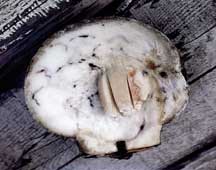 |
Sea scallop with a bacterial abscess on the adductor muscle (meat) and worm burrows throughout the shell. The worms are a type of polycheate, Polydora sp. |
Disease synopsis
I've tried to give you a sampling of scallop diseases from the extensive menu found at the "Diseases of Shellfish" web site. This synopsis was designed to be a source of basic information, including key references to pertinent literature, as well as other information that is often not readily available, such as research laboratory reports, government technical reports, and personal communications with colleagues.
If scallops, or any other shellfish, are ever candidates to take up residence on your farm, turn on that computer and give it a look.
Rod Getchell works in the Aquatic Animal Health Program at the Cornell University College of Veterinary Medicine.

Please contact
Fish Farming News for reprint information
and permission. - © Compass Publications, Inc.,
2000