Mechanical pond circulators
Colombian shrimp farm performance trials
I recently had the privilege to spend a few days in Nice, France and attend the Aqua 2000 conference produced by the World Aquaculture Society (WAS) and the European Aquaculture Society.
My trip was paid for courtesy of the US Aquaculture Suppliers Association (USASA) because I won the trade show "treasure hunt" at the WAS meeting in New Orleans earlier this year. Thanks, USASA. We had a great time.
While at the Aqua 2000 trade show, I made a point to look for aquaculture products or equipment applications that might make suitable topics for this Systems Engineering column. My backpack runneth over with new product literature as I left the trade show.
I found an engineered products company called ETec S.A. that was new to me and a product/application a pond water circulator that I've always felt was underutilized in aquaculture.
I also obtained an excellent report on the product written by the US number one pond expert, Dr. Claude E. Boyd of Auburn University, who designed a challenging performance testing program for this pond water circulator.
Most of what follows is based on Dr. Boyd's report, which was recently released by ETec S.A. The study and report are the results of a cooperative effort by ETec, C.I. Oceanos shrimp farm, and Corporacion Centro de Investigacion de la Acuicultura en Colombia.
Increase production
Numerous studies suggest that high-volume, low-head water circulators can be used to enhance water circulation and mixing in aquaculture ponds. These studies also suggest that mechanical water circulation can improve pond bottom soil conditions and water quality. The carefully engineered application of water circulator technology can save money and increase pond production.
ETec S.A. of Cartegena, Colombia has designed an axial-flow water circulator especially for use in semi-intensive shrimp farms. Dr. Boyd's task was to design a comparative performance trial, provide assistance during the trial, and analyze the resulting data.
Let's take a look at the equipment and the performance parameters that must be considered when engineering a solution that employs pond water circulators.
Water circulator
The mechanical water circulator consists of a large, single propeller suspended from a flotation system and powered by a small diesel engine via a belt drive.
The major features of the ETec device are as follows:
-
Type of engine Diesel (2 cycle, electric also available);
-
Engine size 7.5 hp (5.6 kW);
-
Applied power 5.5 hp (4.1 kW);
-
Propeller diameter 36" (91.44 cm);
-
Propeller material Fiber reinforced plastic, UV stabilized;
-
Propeller speed 220 rpm;
-
Operating depth (from surface to top of propeller) 6" (15 cm);
-
Fuel consumption 0.32 gal/hr (1.2 L/hr);
-
Water flow 22,200 gpm (84 m3/min); and
-
Supporting structure Galvanized metal with epoxy coating.
Performance trials
Experimental performance trials were conducted in nine shrimp ponds at C.I. Oceanos shrimp farm in Colombia to determine the influence of ETec water circulators on movement of water, water quality, bottom soil condition, and shrimp production.
One water circulator was placed in each of six treatment ponds of 15-20 acres in area. Water circulators were operated 12 hours per day or 24 hours per day for periods of 84-100 days depending upon the pond. Three control ponds were operated without the added circulator.
Gypsum blocks were strategically placed throughout the ponds to indicate relative water circulation, which was indicated by the relative loss of gypsum block material.
The shrimp ponds used in the trials had high-quality source water and good bottom soil condition. The ponds were stocked at moderate rates and pond management was viewed as excellent.
As a result and somewhat to the detriment of the performance trials, water quality and bottom soil deterioration did not occur in the control ponds. Thus, there was no opportunity to demonstrate the benefits of water circulation on shrimp pond ecology and shrimp production.
Nonetheless, positive aspects of enhanced water circulation were demonstrated, including: a decrease in degree of dissolved oxygen stratification in the afternoon; lower total ammonia nitrogen concentration; less blue-green and green algae; and more diatoms.
This suggests that mechanical water circulators can enhance environmental conditions in ponds.
"In ponds stocked and fed at higher rates, or in ponds with impaired intake water quality or problematic soil conditions, mechanical water circulation would no doubt have measurable benefits on shrimp survival and production," Dr. Boyd stated.
Experimental design
The experimental design consisted of three treatments each replicated in three ponds as follows:
|
Treatment
No mechanical circulation |
Designation
Control |
|
One ETec water |
12
hr/day
circulation |
|
One ETec water |
24
hr/day
circulation |
Water circulators were installed near one end and along the side of each treatment pond. Water flow was directed parallel to the long axis of the pond. Where possible, water flow was in the direction of the prevailing wind. The circulators were mounted beside a small platform to facilitate fueling and maintenance.
Ponds varied in area from 15 to 20 acres and in average depth from 3-1/2' to 5'. The water circulators were installed in the smaller ponds and larger ponds were used as controls. There was considerable variation in the direction of orientation of the long axes of the ponds.
Here's how the trials were conducted.
-
Circulator operation The water circulators were refueled and subjected to maintenance checks daily. The dates of initiation and cessation of mechanical water circulation were recorded. The percentage of down time was computed and the hours of operation calculated for each pond.
-
Weather Rainfall was measured daily with rain gauges located at the shrimp farm. Wind velocities were estimated with a portable, handheld wind speed meter. Sky conditions were recorded as cloudy, partly cloudy, or clear.
-
Pond management Records were obtained on amounts of fertilizers (ammonium nitrate, Agrimin, and sodium silicate), lime (calcium hydroxide), and organic matter (soybean meal and Posturina) applied to ponds. Posturina is a commercially available chicken feed. The ponds were limed with calcium hydroxide and treated with organic matter before being filled with water. . . . . .. . . . . After being filled with water, the ponds were fertilized to obtain a plankton bloom. The shrimp postlarvae (PL) were then stocked at approximately 1.3-1.4 PL/ft2 (14-15 PL/m2). The shrimp were fed with a commercial ration daily throughout the production period. Fertilizers were applied to the water as needed to maintain the plankton bloom.
. . . . . The production period ranged from 112 to 130 days in the different ponds. Ponds were harvested by draining.Shrimp were collected and the following data obtained: survival percentage; average individual weight of shrimp; harvest weights of shrimp from ponds; and feed conversion ratio (weight of feed applied divided by weight of shrimp harvested).. . . . . All ponds were operated under normal production procedures. The only differences in management among the ponds were the presence or absence of the circulators and the length of time that the circulators operated per day. -
Water circulation Water movement in the ponds was estimated by the gypsum block technique. In this procedure, the weight loss of gypsum blocks positioned at different places and depths in a pond relative to the weight loss of gypsum blocks held in quiet, confined water in a container is used as an index of water movement. Studies have shown a very close relationship between rate loss of gypsum blocks and water velocity over blocks.
-
Water quality The water quality measurements included water temperature, salinity, dissolved oxygen, Secchi disk visibility, total ammonia nitrogen, and phytoplankton abundance. Temperature and dissolved oxygen measurements were made near the water surface, mid-depth, and near the bottom at two locations at the center and near the exit gate in each pond. Samples for ammonia nitrogen concentrations, salinity, and phytoplankton abundance were taken from surface water near exit gates.
-
Soil condition The evaluation of soil condition was somewhat subjective. Soil cores were removed from the pond bottoms with a clear plastic tube. The color of the surface layer (soil layer in contact with water) was observed and recorded. The depth below the surface of the top of the black, highly oxidized layer also was measured.
. . . . . Brown color at the soil surface indicates an oxidized condition and gray and black sediments are reduced. A greater depth to the black layer suggests a more oxidized and better soil condition than a lesser depth to the black layer.
Weather, problems
Windy conditions are common at C.I. Oceanos shrimp farm and, during the study, wind speed was often above 6 mph. Wind direction was roughly parallel to the long axis of the ponds 35.3% of time in the control ponds and 23.7% of the time in both of the water circulation treatments.
The majority of days were partly cloudy or clear, so there was plenty of sunlight to stimulate photosynthesis by phytoplankton. Temperatures in the water column usually were 84°-86°F in the early morning and around 86°-88°F in midafternoon throughout the study.
Mechanical problems mainly excessive vibration, faulty propellers, and loose belts occurred with the circulators. As a result, the circulators were not in continuous operation. ETec used the experience gained from the circulator malfunctions to improve the design of the machine. Units fabricated in the future should be more reliable than the units used in this study.
Temps, dissolved oxygen
A tremendous amount of data was collected on water temperature and dissolved oxygen. Measurements were made twice daily at 0600 hours and 1500 hours and additionally at 1200 hours and 1800 hours on some days at three depths (surface, mid-depth, and near bottom) and two locations (near exit gates and near centers) for all ponds.
No clear differences could be found in water temperatures or dissolved oxygen concentrations between control ponds and ponds with water circulators.
Water temperatures and dissolved oxygen concentrations were lower at 0600 hours than at 1500 hours as is normal in ponds and many other water bodies. Water temperatures were essentially uniform at 0600 hours in ponds of all treatments, suggesting that ponds were not thermally stratified in the morning even where water circulators were not used.
It is common for aquaculture ponds to destratify during the night when surface water cools as a result of heat loss by convection. The ponds with water circulators did not thermally stratify strongly during the day as evident from similar water temperatures at all depths at 1500 hours.
Dissolved oxygen concentrations were only slightly different between the surfaces and bottoms of ponds at 0600 hours, but stratification of dissolved oxygen was more pronounced at 1500 hours.
Thus, it appears that the action of the water circulators lessened stratification of dissolved oxygen in the ponds. However, because the control ponds did not stratify thermally, the full benefits of mechanical circulation on destratification of water temperature and dissolved oxygen concentration could not be demonstrated in this study.
Water movement
Weight losses of the gypsum blocks resulted from dissolution of the gypsum. The faster the water flows over the blocks, the greater the weight loss per unit time.
The weight losses from gypsum blocks were greater in the surface water than at mid-depth or near the bottom in all ponds. In general, the weight losses and, thus, water movement were greater in the ponds with mechanical water circulators than in the control ponds.
The greatest weight losses were for the 24-hour day circulation treatment.
Soil condition, algae
The soil condition in ponds was evaluated based on: color of surface soil where brown=oxidized, gray=moderately reduced, and black=highly reduced; minimum depth to the black layer (the greater the depth the more desirable); and redox potential (the more positive the value the better).
There was no obvious improvement in soil condition as a result of mechanical water circulation. Of course, this observation does not suggest that water circulation is not beneficial because the control ponds did not exhibit deteriorated bottom soil condition.
In ponds with problematic soil condition resulting from high rates of organic matter accumulation, water circulation could be highly beneficial.
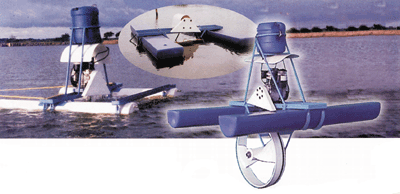 |
The ETec S.A. mechanical water circulator consists of a large, single propeller suspended from a flotation system and powered by a small diesel engine via a belt drive. |
Average values for Secchi disk visibility did not differ among the treatments and controls. Total ammonia nitrogen concentrations tended to be less in the ponds with mechanical water circulation than in control ponds. The ponds with water circulation tended to have less blue-green and green algae and more diatoms than did the control ponds.
Shrimp production
Data on shrimp production were remarkably similar among treatments and controls. The range in production for all ponds was 940 pounds/acre (1,053 kg/ha) to 1,220 pounds/acre (1,364 kg/ha).
The feed conversion ratios ranged from 1.06 to 1.35 and averages for the water circulation treatments were similar to the average for the control ponds.
Survival was good in all ponds and averaged above 60%. Shrimp size at harvest also was similar among treatments and control. Thus, water circulation as applied to the ponds in this study did not have a measurable influence on shrimp survival or production.
However, it again must be noted that problems related to survival, growth, and production did not occur in control ponds, so there was no opportunity to demonstrate the expected benefits of mechanical circulation.
Conclusions
The conditions for evaluation of the mechanical water circulators at C.I. Oceanos shrimp farm were not ideal. There was usually a brisk breeze, and water motion caused by wind action greatly lessened the possibility of benefits from mechanical water circulation.
Test ponds were stocked at moderate rates, water exchange was conducted with high quality water, and pond management practices were excellent. Therefore, ponds did not have water quality problems or impaired bottom soil condition that would benefit from the application of mechanical water circulation.
The results of the study did reveal that water circulation caused some effects that would be beneficial in shrimp ponds where water quality and bottom soil conditions are sub-optimum.
Afternoon stratification of dissolved oxygen concentration was reduced and weight losses from gypsum blocks were greater in the ponds with mechanical water circulation.
Both observations suggest that the ETec water circulators increased the circulation and mixing of water in ponds. Greater mixing of the water column provides more uniform water temperatures and dissolved oxygen concentrations and more circulation moves a greater amount of oxygenated water over the pond bottom to maintain aerobic conditions.
The ponds with mechanical water circulation had lower total ammonia nitrogen concentrations than the control ponds. This probably resulted from greater diffusion losses of ammonia to the air in the circulated ponds. Lower ammonia nitrogen concentrations in ponds are desirable because concentrations of total ammonia nitrogen above 1 or 2 ppm can possibly result in toxicity of un-ionized ammonia to shrimp.
The ponds with water circulators also had less blue-green and green algae and a greater proportion of diatoms than control ponds. Shrimp farmers in South and Central America tend to prefer diatoms to other types of plankton algae, so more diatoms can be considered as a desirable effect.
Improvements
The results of this study suggest that water circulation induced by ETec water circulators can have beneficial effects on environmental quality in ponds and favor better conditions for shrimp production.
However, these effects will be difficult to demonstrate in ponds where soil and water quality have not deteriorated enough to cause adverse effects on shrimp. The lack of a strong influence of water circulation on temperature and dissolved oxygen stratification in the water column suggests that more than one water circulator should be used in a 15-20 acre pond.
The study also was very beneficial in allowing ETec to improve the design of the water circulator based on problems observed during operation of the devices under commercial conditions. Improvements made in the water circulator during these trials will make future units more reliable and reduce maintenance costs.
In ponds where water quality and bottom soil conditions are less than optimum, water circulation may have considerable benefits. Also, on shrimp farms where stocking and feeding rates are fairly high, operation of water circulators may provide a safety factor by preventing the onset of bad environmental conditions in culture ponds.
The results of this study are encouraging, and further investigations on water circulation are badly needed. Producers may want to invest in water circulation trials in selected ponds to determine if the technique will be beneficial under conditions existing on their shrimp farms. n
Paul Hundley is president and principal engineer for Applied Aquatics Inc. in Charleston, SC. He has more than 25 years experience in the design, construction, and operation of commercial, industrial, and institutional facilities and has been working in aquaculture for over 10 years.
Hundley can be reached via: phone (843) 971-9639; fax (843) 971-9641; or e-mail <[email protected]>. Copies of this and other Systems Engineering articles are available at <www.AppliedAquatics.com>.
Note: Some of the information contained in this article has been generated by independent sources. Such information is accurate to the best of the author's knowledge, but the author disclaims any liability for the accuracy or completeness of such information or the reliance by any party on such information. Reader comments and corrections are welcomed.

Please contact
Fish Farming News for reprint information
and permission. - © Compass Publications, Inc.,
2000