Rundown of spiny lobster culture considerations
|
FT. PIERCE, FL - The spiny lobster, Panulirus argus, is an important fisheries resource in the Caribbean and Florida region. It is a highly valued seafood product with large existing markets. In recent years, there has been a lot of interest in commercial farming of spiny lobsters. Harbor Branch Oceanographic Institution Inc. (HBOI) has investigated the physiology and culture potential for P. argus for the past decade.
|
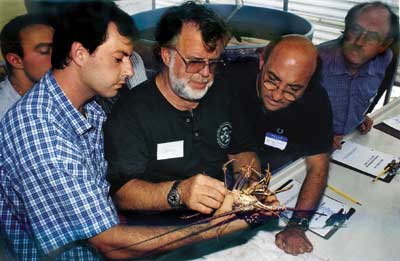 |
| An instructor gives students a spiny lobster anatomy lesson during a workshop on spiny lobster biology and culture methods at HBOI's ACTED facility. The next workshop is scheduled for April 2001. |
Spiny lobsters are found in shallow waters (less than 150 feet) where they inhabit rocky bottoms, coral reefs, and grass flats. They are found in any habitat that allows concealment from predators.
Commercial aquaculture of spiny lobsters can be divided into three categories:
l Full-cycle mariculture. Rearing the animal from eggs produced by captive broodstock and develop a husbandry protocol and genetic lineage. Full-cycle mariculture of spiny lobsters is extremely difficult because of the long and complicated larval life cycle (for P. argus it is estimated to be 400 days). As of this time, hatchery production of juvenile spiny lobsters is not technically feasible.
l Growout of wild-caught postlarvae. The postlarvae or pueruli are produced in the wild, collected, and cultured for approximately 18-20 months, when they reach one pound in size.
The pueruli are collected as they drift inshore. The collectors are floating artificial habitats consisting of a PVC frame from which artificial substrate is suspended in the water column. The transparent pueruli will settle on the collectors and remain for 7-14 days, while they pigment and metamorphose into the first juvenile stage. Recruitment is strongly influenced by the lunar cycle, the new moon stages being the most productive.
Studies conducted at HBOI demonstrated that after the juvenile lobsters reached about 10 grams, they were housed in communal groups without apparent loss from cannibalism or selective growth retardation. These lobsters were fed fresh seafood products. HBOI is actively researching the development of a formulated feed for commercial aquaculture of spiny lobsters.
l Post-harvest impoundment of juvenile or adult animals. Small or legal-sized lobsters are captured in the wild and grown to a larger market size. Newly recruited lobsters to the fishery are still within their exponential growth phase.
Preliminary studies at HBOI indicate that lobsters in the 400-500 gm weight range have an intermolt period of 60 days and a molt increment (% weight increase) of 39%. Therefore, impounding a spiny lobster of this size range through one molt will increase the product value by 35%-40%.
Marketing lobsters live or whole-cooked will further increase product value by 30% to 36%.
Thus, impounding lobsters has the potential to significantly increase lobster value with no increase in exploitation or impact on the wild population. Use of fishery byproducts as lobster feed not only lowers production costs, but also provides a beneficial use for seafood processing wastes, which constitute a significant source of pollution adjacent to the processing plants.
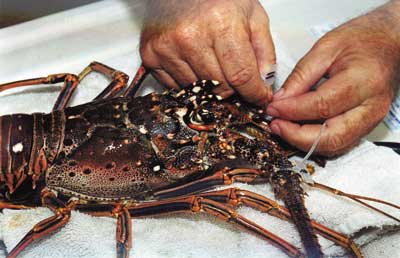 |
HBOI's spiny lobster research program has included tagging broodstock | |||
| Weighing impounded lobsters to monitor viability of growing out small spiny lobsters to a larger market size. | 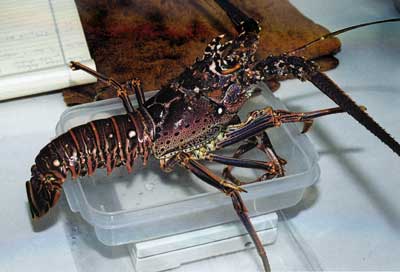 |
|||
The biological parameters of impounded lobsters that need to be assessed include: evaluating the health of lobsters received from trap boats and staging lobsters within the intermolt period through observation of morphometrics, evaluating molt weight increases and survival of premolt and postmolt lobsters, and establishing feeding rates and feed conversion.
Site evaluation
To identify a suitable site for growout of wild-caught postlarvae or post-harvest impounding in ocean-based systems the following variables need to be evaluated:
-
Water circulation;
-
Bottom-type;
-
Protection from weather;
-
Access to shore facilities; and
-
Security.
Growout in land-based systems will require access to high-quality seawater. The system should be recirculating in order to avoid discharge into coastal waters.
System specifics
Growout of wild caught postlarvae: The recruitment and collection procedures are already well established for lobster postlarvae. Research is still needed to determine the most effective rearing systems for growout of postlarvae. Potential growout systems include casitas and cages for ocean growout and tanks and raceways and ponds for land-based growout.
Post-harvest impoundment: In order to growout harvested lobsters, it is necessary to design and construct net pens to hold the lobsters during the impoundment period and to evaluate materials and methods for holding lobsters that exclude predators and maximize operational efficiency (e.g., feeding, harvesting, and handling).
For land-based growout systems it is important to ensure environmental sustainability. Land-based systems for lobster farming should be based on a "zero discharge" policy to the greatest extent possible. This will prevent excessive nutrient discharge in surrounding waters, which are very sensitive to suspended solids and nitrogenous wastes.
Market potential, economics
There are a number of market opportunities for spiny lobsters. The global market for spiny lobsters continues to be robust, due to high demand and limited supply. There are several product forms: whole raw, whole cooked, tails raw, tails frozen, and live whole lobster.
Aquaculture production of spiny lobsters, either through collection and growout of postlarvae or through post-harvest impoundment will require a value-added product form in order to be economically feasible. Cultured spiny lobsters will not be able to compete with the frozen tail market.
Other products that can be marketed include postlarvae for growout facilities and small juveniles for the aquarium trade.
Recommendations
Impoundment of adults for either the live or whole-cooked market is an immediate opportunity to increase the value of the spiny lobster fishery in the Caribbean and Florida. However, it must be coordinated with fishermen (trap or diving) who are willing to collect live lobsters and hold them for future sales.
The ability to provide a formulated feed that is palatable and promotes growth has yet to be developed. This is the most significant constraint to lobster impoundment practices. Once this research is completed, a pilot-scale production facility should be undertaken to demonstrate the economic feasibility of lobster culture.
The option to collect postlarvae needs two areas of research: (1) the feed issue described above must be addressed, and (2) the capability to collect large numbers of pueruli or postlarvae need to be worked out in terms of the regulations and permits needed for collection.
In addition, any growout system other than a temperature controlled greenhouse will result in temperature fluctuations beyond the optimum for spiny lobsters and will potentially impact the growth, survival and feed conversion ratios.
The Aquaculture Center for Training, Education, and Demonstration (ACTED) at Harbor Branch Oceanographic Institution offers workshops on Spiny Lobster Biology and Culture Methods. The next scheduled workshop will be April 2001.
For more information contact: ACTED; phone (800) 333-4264 or (561) 465-2400 ext. 416; fax: (561) 466-6590; or e-mail [email protected].
