P. vannamei in near-freshwater recirculating systems
ACTED course teaches new intensive shrimp culture practices
FT. PIERCE, FL - Over a decade ago the Aquaculture Division of Harbor Branch Oceanographic Institution established itself as one of the leaders in the development and transfer of new technologies for the cultivation of commercially important aquaculture species.
Harbor Branch staff have been very active in community-based retraining programs. Approximately 350 displaced fishers graduated from a federally supported retraining program that was conducted in Florida at four Harbor Branch field stations. At the end of the one-year training program, graduates received clam seed to plant on their new lease site. That allowed graduates to immediately begin their new occupation as shellfish growers.
The majority of the clams farmed in the state of Florida are produced by fishers who completed this community-based retraining program. Florida Agricultural Statistics Service reported that in 1997 clams accounted for $12 million of aquaculture sales in Florida. That makes clam farming the number one aquacultured food species in the state.
In the past year, Harbor Branch aquaculture staff have begun the transfer of a new technology. A study conducted by Harbor Branch researchers and funded by the Florida State Department of Agriculture and Consumer Services demonstrated the technological feasibility of culturing the marine shrimp Penaeus vannamei in high density, freshwater recirculating aquaculture systems.
The tolerance of Pacific white shrimp to low salinities has greatly expanded the potential locations for shrimp aquaculture in Florida and elsewhere. Harbor Branch researchers have been successfully producing P. vannamei in hard freshwater with chloride concentrations as low as 300 ppm.
It was only a few years ago that shrimp farming in Florida was not considered to be economically feasible because of the high cost of coastal property, a short growing season, and a strict regulatory environment.
"The fact that we can grow shrimp in near-freshwater recirculating systems overcomes many of these limitations and allows shrimp production to be practiced in areas where less expensive agricultural land is available," said Peter Van Wyk, project leader.
A few operations in Florida, Indiana, and Arizona have begun producing shrimp using these new technologies.
Three-phase system
The Harbor Branch researchers have designed a low-cost, three-phase production system that is capable of producing market size (18 gram) shrimp in 180 days .
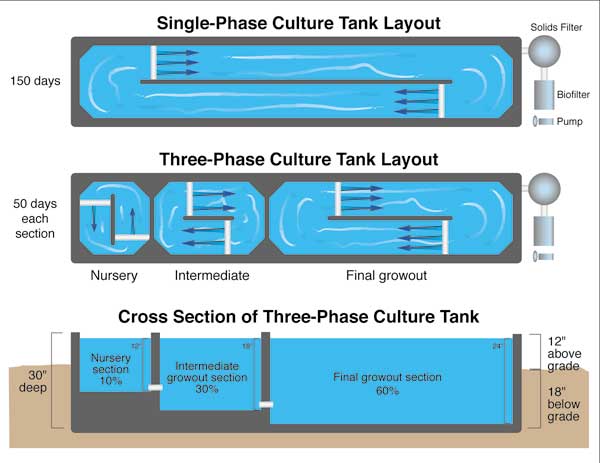
The shrimp in the demonstration study grew 0.7 grams per week when temperatures averaged between 26°-28°C. Density at harvest averaged 135 shrimp per m2 and survival over the growing period averaged 61%.
The advantages of the three-phase system are that production is approximately 1.8 times higher compared to the traditional single-phase system and shrimp can be harvested every 60 days. This translates to a higher economic return for a given area of space.
It is recommended that the three-phase recirculating system be located indoors in greenhouse buildings. This arrangement provides cost-effective protection from adverse weather conditions and affords some level of control over environmental parameters such as temperature, light intensity, and relative humidity.
In temperate climates the use of recirculating systems in greenhouses can often enable the species to be produced year-round to increase annual revenues. Continuous harvesting facilitates direct marketing to retail outlets, which may allow for a higher price to be received for the product.
Producing shrimp indoors in recirculating systems also benefits the producer by significantly reducing the risk of exposing the shrimp to viral diseases that have wreaked havoc in open coastal ponds throughout the world. Greenhouses also protect the crop from losses resulting from predation or theft. In addition, these systems substantially reduce the risk of accidental release of non-native shrimp into coastal waters.
Harbor Branch is currently selling these farm-raised shrimp to direct markets. The shrimp are sold fresh on ice for $5-$6 a pound with the heads-on.
It has been suggested that the most feasible marketing strategy for these intensively grown shrimp is to direct market to restaurants, retail outlets and consumers. These shrimp cannot compete with imported, fresh-frozen shrimp prices in the commodity market.
Because there is limited information on the direct markets for marine shrimp raised in intensive freshwater recirculating systems, a marketing and product acceptance study is being funded by USDA.
This study will be conducted by University of Florida, Florida Department of Agriculture and Consumer Services, and Harbor Branch Oceanographic Institution. It will address issues such as which direct markets are most attractive, what are product requirements, what are customers attitudes, and what are the product quality and safety standards.
This new technology has generated a tremendous amount of interest on a national and international level. In 1999 the Harbor Branch Aquaculture Center for Training, Education, and Demonstration (ACTED) offered three 5-day Intensive Shrimp Culture courses.
Of the 37 participants who attended these courses, 13 came from Florida, 10 from other states in the USA, and 14 from overseas. International participants were from Japan, Egypt, and Italy; though most international students come from Central and South America where shrimp farming is a major economic enterprise.
Several factors contribute to the high level of interest among Latin American aquaculturists. Most important is the increased need for new technology in shrimp farming. Older methods, while reliable, are beginning to be outpaced by disease factors, with many shrimp farmers being challenged with high mortality rates from viral diseases such as White Spot Disease and Taura Syndrome.
Reliable production of Specific Pathogen Free (SPF) shrimp is the single largest issue facing the shrimp culture industry, both in the United States and in Latin America. How to satisfy this need is the driving force behind research into new methods and improved technologies. It has lead to a reconsideration of closed-system aquaculture and recirculating systems as a means of controlling disease, limiting water usage, and improving biosecurity.
Peter Van Wyk, HBOI lead shrimp course instructor, emphasizes that the key to starting a freshwater shrimp farm is acquiring Specific Pathogen Free high quality postlarvae (PL) acclimated to fresh water.
"We have discovered that shrimp can be acclimated to hard freshwater at PL 12-15, after the gills are fully developed" said Van Wyk.
Training course content
During the 5-day course, participants train in techniques to acclimate postlarvae from salt to freshwater. They also learn recirculating technology and water quality parameters for optimal growth and survival of shrimp.
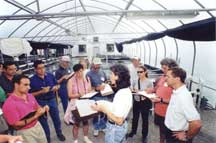 |
Peter Van Wyk, far right, and Megan Davis-Hodgkins, center, train course participants on intensive shrimp farming practices. |
Health management is also an important topic covered in the course. Dr. Rolland Laramore, technical director of the Harbor Branch Aquatic Animal Health Laboratory, and research scientist Susan Allen provide the participants with a real-world approach to shrimp preventative health practices. They also introduce diagnostic procedures for gene probe, PCR, histology, and microbiology that are used in the Aquatic Animal Health Lab to detect diseases of cultured penaeid shrimp.
Dr. Edward Scura, president of Shrimp Improvement Systems, discusses with the participants what biosecure methods can be used to improve pond production.
The participants are exposed to the latest technology used to increase survival and density in nursery production of shrimp. Jeff Peterson, senior technical services representative from Meridian, discussed the use of artificial substrate in intensive nursery production.
With the epidemic virus White Spot moving through the industry, business managers are looking for alternatives to traditional pond culture. Techniques such as recirculating systems in the nursery stage and stocking with SPF postlarvae are alternative strategies to shrimp production in ponds and raceways.
Dr. Megan Davis, program manager for ACTED, summarized, "Harbor Branch is the ideal setting for shrimp culturists seeking to address these issues, because they are able to take advantage of the many years of applied research and testing performed by HBOI researchers and on-site private industry partners." Harbor Branch will continue to offer workshops on shrimp culture and intensive short courses on hatchery and nursery operations in the year 2000, Davis said.
For those interested in learning more about the new techniques, the publication "Farming Marine Shrimp in Recirculating Freshwater Production Systems" has recently been completed by Harbor Branch aquaculture researchers. It provides details on the design and operation of these shrimp farming production systems and an economic analysis.
The publication is intended for field use by shrimp farmers, students, and extension agents. The chapters cover greenhouse construction, principles of recirculating system design, shrimp production systems, receiving and acclimation of postlarvae, nutrition and feeding in intensive systems, water quality requirements and management, shrimp health management, production and market planning, and economics of shrimp culture in recirculating systems.
For information on how to get the publication or on the training courses, contact Harbor Branch Oceanographic Institution at phone (561) 465-2400 ext. 416; fax (561) 466-6590; or e-mail <[email protected]>.

Please contact
Fish Farming News for reprint information
and permission. - © Compass Publications, Inc.,
2000