Bird predation prevention
|
Part I: Effective, inexpensive netting covers
"Old MacDonald has a farm, e-i-e-i-o; and on that farm he has a pelican, e-i-e-i-o, with a virus here, and trematodes there, sick and dying fish everywhere ... old MacDonald HAD a farm, e-i-e-i-o." |
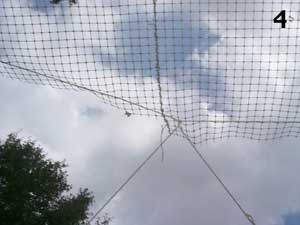 |
| A seam holds two panels together, laced mesh-to-mesh for best strength. |
The problems faced from bird predation as well as biological infestation of ponds from fecal droppings is steadily on the increase. Aquaculture and birds are now spoken in the same breath. They are symbiotic and will remain so. The only defense is to how to lessen the contact between your pond and their webbed feet.
It was just about a year ago that white pelicans were fingered as one of the culprits in the trematode infection of catfish, and we'll soon be into the season when hungry birds start arriving pond-side.
I asked expert Jimmy Avery, who is an associate extension specialist at the National Warmwater Aquaculture Center at Mississippi State University, about the problem.
"Catfish farmers in areas experiencing pelican pressure should be concerned about the possibility of parasite transmission," Avery said. "Recently, an internal parasitic trematode has been found in channel catfish from Louisiana, Mississippi, and Arkansas. The life cycle of this parasite is believed to begin in the American white pelican, move into the ram's horn snail, and from there infect catfish in commercial production ponds."
The result of the infection ranges from diminished feeding in larger fish to death in smaller fish.
According to Avery, the more common fish-eating birds like great blue herons and great egrets also serve as a vector for other parasites. However, these infections are not as serious to catfish.
The real threat by these birds is the amount of small fish they eat, Avery said. A recent study by the USDA National Wildlife Research Center indicated that great blue herons typically consume 12 4-inch fingerlings daily.
"These losses when added to the cost of deterring these birds have a significant impact on the economic viability of the catfish industry," Avery said.
What to do
I have spoken with numerous fish farmers and researchers who have 70%-90% losses in some ponds.
One Louisiana farmer told me he has documented evidence of a $900,000 loss in eight years.
"I spent $28,000 in one year, just hiring crews to give me 24/7 protection from feeding birds," he said.
Several very important projects were completely wiped out by birds leaving the researchers with no information and setting back the research data by years. The cost to the university or hatchery, as well as to the taxpayers who fund them, is growing each year.
Missing fish are one thing. You know they are gone and probably eaten and digested. But the injured or wounded fish that the heron or cormorant just couldn't hold onto is still in your pond. It will soon be suffering from secondary infections from the wounds inflicted and could cause more serious problems to the entire pond or tank population.
In this FFN and the next issue, the Gear Shop will be devoted to a look at some innovative yet simple techniques for keeping birds and other creatures out of the pond or tank. Although the 40 grain .22 slug and the #6 lead shot is still thought to be the definitive answer, legal and ecological factors will rule this solution unacceptable.
"It's just a matter of time before they dictate that we only harass or fill our kill permits with steel shot," said a fish farmer from Arkansas. "All that lead we throw at them birds still winds up in the pond and someone is going to take note pretty quick."
Netting covers
I am a net maker. My expertise in bird problems is limited to using netting to keep the critters out altogether. If they cannot get to the water, they cannot eat what's in the water. Aside from expensive fencing or shock wire, netting is and will continue to be the most economical bird-proofing. What is used and how it is deployed makes the difference between successful protection or a waste of money.
Let's start with the easiest of areas to cover, the round tank. Outdoors or inside round tanks are always stopovers for kingfishers, merganzers, and some herons.
Most of the well-built tanks have a solid 2" lip around the outside of the tank. It has always been a perfect place for predators to perch and feed. It is also the ideal place to hold a ring net or a patch net.
| Photo 1, at the upper right, shows a patch net installed on an outside 8' diameter tank. A patch net is simply a square section or patch of netting stretched over the tank and held in place by a tightly strung twine just under the lip. Total cost to the researcher, $6 per net and 3 minutes of time to install. Notice that the large 150mm nylon mesh allows fingerlings as well as feed to be dumped in and any aeration hoses inserted through the mesh. | 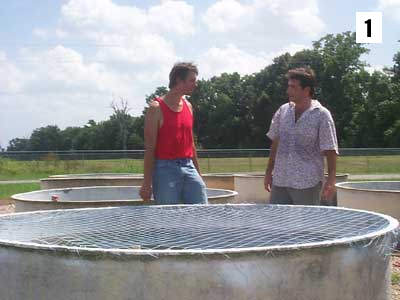 |
| Christian Balnath and Scott Broussard look over a patch net on an 8' diameter fish tank. |
| Photo 2 shows a ring net installed on a 16' diameter Red Ewald fiberglass tank. There is no framework in the tank and the netting does not touch the water. You can see that all hoses and oxygen meters simply slip through the 75mm mesh. | |
| Broussard examines a ring net installed over a 16' diameter fingerling tank. |
The ring net is tied under the lip just like the patch net. In this case though a retaining line is fitted on the inside of the net, making a donut or ringed shape. The inside line holds pressure on the net so that it does not touch the water and provides excellent protection from fish jumping out or birds getting in. Average costs start at $55 per net.
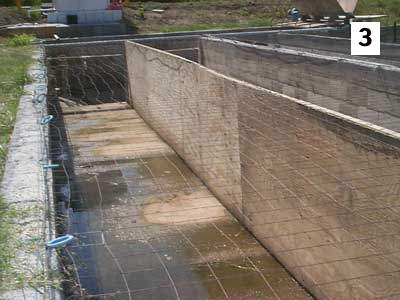 |
As seen in photo 3, large square mesh is strung extremely tight across the top walls of a brand new raceway system. The 175mm square mesh allows for any size fish to be dropped in as well as any type feed. The large mesh simply keeps birds from getting into the raceway. By keeping the water level just 6" under this net, operators are assured that no bird standing on the edge can pick off a quick snack . |
| A square mesh nylon cover net is installed over a raceway. |
The cabled runners seen on each side allow the net to slide back when harvesting begins. It is also important to have this type of net held in place by a cable so that, as the nylon mesh shrinks or stretches, the cable can be adjusted to keep the netting tight. Depending on installation techniques, this type of set-up costs the farmer approximately 24 cents a sq/ft, including cable.
For those covers made from extremely thin material, there are some tricks to a successful deployment. Seen in photo 4 is a 20-pound tensile-break netting that has been in place for four years with no problems.
You can see that the seams are laced mesh to mesh. This guarantees that when the wind does blow, the entire length of the net acts as one singular unit with the strain being imparted to the whole panel, not just one mesh.
Problem installations
Does a torn net just mean birds eating fish or contaminating water? In the case of one Florida farmer it cost him a pond full of fish when the netting dropped into the water and was sucked into the paddlewheel aerator.
Another newcomer to bird netting learned the hard way about support structure (guy lines, border lines, and stress seams). "It shredded apart in 30 minutes. $20,000 worth of netting and it was gone in less time than it took for me to take it out of the boxes. The next morning the birds came in. We were busy clearing the shards of ripped netting out of the front ponds. By the time we could get to the back ponds they had put a serious dent in our fingerling population."
This conversation was short and ugly. The farmer was totally disgusted and looking for a lawyer. He had purchased some "economical" bird netting without borderlines or support lines.
The salesman recommended simply connecting the netting to the outside perimeter cable with tie wraps or hogs rings. The cable ties the farmer installed every few feet could still be seen holding one and only one mesh.
When the winds picked up to 25 knots that night, the entire panel began whipping up and down. This whipping action produced a shock load several times greater than the netting's MSDS tensile strength rating. "All the strain was placed right at that one hog ringed mesh. It came down like a house of cards."
One tip: Any knotted netting automatically loses 35% of its tensile strength due to the knot. So if the ad says 50-pound tensile per strand, you had better ask if that was measured before or after the strand was knotted into a mesh.
Already lined up for the next FFN are new designs of bird net that allow complete coverage for less than 12 cents a sq/ft, lasting for five to seven years, and successfully tested in a 75 mph wind storm. Also, "Sticky Wire" border strips designed to keep birds, turtles, snakes, and fish-eating mammals away from your pens and cages.
Greg Faulkner operates a net shop and can be reached at PO Box 115, Milton, LA 70558, or e-mail: [email protected]
