Using the Beam'R sampling net
"So how do I test my ponds for crawfish concentrations if I don't have my traps in the water yet," he growled. "I guess I gotta just walk out there and feel for 'em." This southwest Louisiana rice farmer was very concerned about his crawfish concentrations, especially since this year marked the worst production on record for the past 30 years. What the farmer wanted to see was the little piece of equipment I had in the truck. It was going to give him a quick and accurate sample without him ever setting foot in the pond. The device is known as a Beam'R. It is a 5' wide net, attached to a 5' long, 6-pound galvanized steel beam. The whole net is rigged to slide around muddy, mucky ponds picking up whatever comes off the bottom.
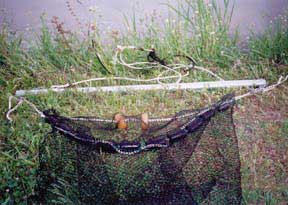 |
Left, the Beam'R net set for use.
|
| Right, the author shows the system's portability. | 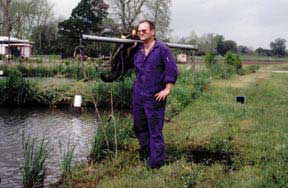 |
The device has been used in fish ponds to test for snails, shrimp ponds to sample stock, crawfish ponds to sample for density and size; and even 3,000' deep in the Caspian Sea to sample marine life on the seabed. It is one versatile little unit. Weighing in at 33 pounds completely rigged, it can be carried to any location, backpacked or even air-lifted. It requires no mechanical retrieval systems. Just lay it out on the far levee or pond berm, uncoil 100' to 300' (or so) of 3/8" rope and position yourself across the pond from the Beam'R, then just pull it through the water. Unless it hits a snag, it can easily be retrieved by hand over distances of up to 500'. Some innovative folks have used a tractor's PTO and a cathead to simply wind it up. The Beam'R can be towed behind or off the side of a hydraulic paddlewheel crawfish rig or from a flatboat with an outboard. It holds tight to the bottom of the pond, raceway or canal while allowing the float line to rise up approximately 24" or so. This device can catch samples as small as 1 mm using one of the many micro liners which can be inserted into the rear of the net. The basic sampling net set-up incorporates a micro-fine mesh with a micro-fine liner inside the net itself. This causes several things to happen. For one, it pushes so much water ahead of itself (a pressure wave) that some species of fish and crustaceans feel the water and get out of the way long before the net reaches them. Too small a liner in the codend or collection bag will act like a sea anchor. It will hold too much water and retain too much debris making the entire rig gain hundreds of bollard pull pounds. In other words, something that weighs 30 pounds on the bank now requires several hundred pounds of pull to make it move through the water. Plus, some small-mesh seines simply do not allow the mud to pass through the micro-fine meshes and it is impossible to produce an adequate water flow. This is bad since specimens are caught in a seine by forcibly pushing them towards the center of the net. Too much mud and nothing moves toward the seine's holding area. In the Beam'R, the front of the net has a large mesh of 30-40mm stretched mesh with a slowly tapering funnel ending up in a square mesh codend. The specimens enter the net and are swept back into the framed codend. The use of a 1/4" steel wire hoop to hold the codend liner open guarantees the water flow will continue into and through the codend. Most specimens will never escape the larger front mesh in the Beam'R because the water flow or interior pressure wave will carry them into the small mesh codend in the rear of the net. This design lets the natural physics of water pressure do all the work. When built using ultra-slick knotless poly, this beam net can be towed in very mucky ponds or canals resulting in minimal mud accumulation. The slush just filters straight through the open, slick mesh. The beam itself rides just above the mud and if it does touch bottom slides over the mud rather than digging in.
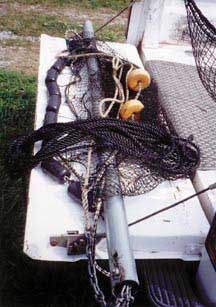 |
The Beam'R in entirety net, boom, and towlines |
By using a heavy gauge knotless polyethylene netting, the Beam'R can cut through the water much easier than with knotted netting. Debris and grass do not hang up as easily as on the knotless netting as they do on knotted material. However, knotted netting in polyethylene material makes an excellent net for use in areas where there are not substantial amounts of grass. Adding a complete set of rubber rollers allows the net to maintain bottom contact while not digging into the substrate. The 3-1/2" x 1-3/4" solid rubber rollers add some weight but do not overload the rig. It can be used equally effectively on a hard cement raceway, across a poly pond liner, or in knee-deep mud. The roller system works on virtually any bottom. Running the net from a boat is relatively easy, requiring only 3-4 horsepower to tow it. These rigs have been used with as little as a light trolling motor. Pond managers can run out on a pond with a small flatboat, toss the Beam'R over, and take a quick "look-see" at what's on the bottom. So what does the Beam'R do for the fish farmer and/or researcher? Well, it can be used to sample crawfish, shrimp or juvenile fish in specific areas of a pond. Since the device requires only one person to operate, it's a simple task to get a sample. Whether you're worried about parasitic snails or possibly diseased fish, this little net can get you a quick sample without compromising your large seine nets. The Beam'R can be disinfected by dipping it into a good dose of chlorinated bleach and water inside a standard garbage can. Shrimp farmers as well as crawfish growers have used the device for sampling size concentrations. They bait an area with feed and drag the net through the area just minutes later. The net can also capture softshell shrimp or softshell crawfish even though these crustaceans do not enter traps while in the soft phase. The Beam'R is used to gather samples by biologists and oceanographers alike. "It was idiot proof," said the graduate student from Florida. "I was assigned to take random samples from the ponds every day. I tried dip netting, cast netting and seining. "The beam net idea was very simple and it guaranteed me that I was sampling more area much more efficiently," she continued. "And, the soft Euro-raschel liner protected the samples. They didn't get roughed up and stressed in the super soft knotless polyester liner." A new project will involve using the Beam'R to sample for mollusks. A double chain system running just in front of the net will dislodge clams from their beds and pop them into the rear of the net where an extra-heavy-netting codend will hold them. This allows researchers to take samples without manhandling the big heavy dredges commonly used for sampling in the past. All in all, the Beam'R is a old idea, right at home in the present and re-tooled for a new millennium of aquaculture. Greg Faulkner operates a net shop and can be reached at PO Box 115, Milton, LA 70558, or e-mail: [email protected]
Netting workshop ready to travel
We have been asked several times recently if we would be willing to take our popular Know Your Netting workshop on the road. The answer: If the demand is there, you bet! Why limit access to the great information offered in this workshop to only those who can make it to the big annual show each year? We'll bring the seminar right to you, your farm, association, organization or extension service, custom-tailored to groups large or small. What's included in the netting workshop?
-
Everything is hands-on, practical, in-the-field type information, including:
-
newest types of netting used in aquaculture around the world;
-
newest types of lines, floats and accessories used in aquaculture;
-
repair techniques for knotted, knotless and braided webbing;
-
new designs of fish pens;
-
new designs of seines (square mesh especially);
-
Safe Haven anti-bird net covers and a rundown of the good, bad and ugly of what's in use already;
-
tank covers;
-
grading nets;
-
netting that is stronger than steel;
-
netting that kills algae all by itself;
-
knotless 2 mm mesh netting that cannot be torn by hand;
-
seine lines that can outbreak cable;
-
rubber rollers for seines that eliminate mud build-up;
-
new types of fish pens that can be harvested by one person;
-
raceway nets and graders that you can build yourself; and
-
a variety of accessories that fish farmers and researchers will find useful in everyday situations.

Please contact
Fish Farming News for reprint
information and permission. - © Compass Publications,
Inc.,
2000