|
Chiasson Aquaculture: Doing it right |
 |
Some time ago I had heard about Yvon Chiasson and his mussel culture operation, Chiasson Aquaculture Ltd., on the northeastern tip of New Brunswick, Canada. My interest really got piqued when we supplied the business with a shellfish point of sale packaging system.
Anybody who has been following my column in Fish Farming News recognizes the management formula I have been promoting "Quality + Quantity = Profitability." I have also discussed the opportunities from product branding and consumer point of sale packaging, which lead to higher consumer sales against the competition of other protein sources.
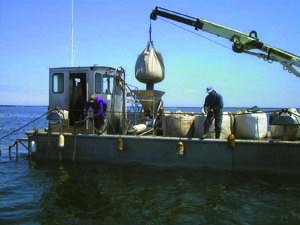 |
A specially built diesel-powered work barge is a key component in the mechanization of mussel farming at Chiasson Aquaculture Ltd. The vessel features plenty of hydraulic power to operate the deck crane, star wheels, and automatic continuous socking machines |
Yvon seemed in tune with my thinking: to sell more product at a greater profit he had to get more people to want his mussels.
In May, I visited Chiasson Aquaculture, which is located on Miscou Island in the Gulf of St. Lawrence. I arrived in Lemeque, a fishing village just a few kilometers from Miscou Island, the night before my scheduled meeting at Chiasson. I got my first exposure to the work Yvon has been doing at a local pub-style restaurant where I had dinner.
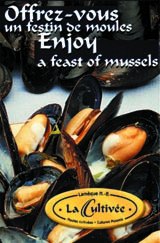
On the table was a triangular card that explained the benefits of Yvon's cultured Fresh Blue Mussels from New Brunswick. From the card, the diner learned how the mussels were grown, in a message from the president himself, along with seeing a beautiful color picture of the product in a cream sauce and Chiasson's distinctive brand name. The only thing that I would have added would have been nutritional values for health-conscious consumers.
I have often commented that the marketing of your product doesn't have to be costly (which is the perception), and many times I have mentioned tabletop cards as an inexpensive way to create demand. Yet, in all my travels, this is the very first time I had seen it.
The beer, wine, liquor, chicken and other food or drink companies have done very well with this type of promoting. They do it because it works and in semi-remote northeastern New Brunswick it worked as well.
I had the mussels and they were as delicious as they looked on the picture. The server stated that with the cards on the table, sales of mussels had gone up considerably and she had to do less promotional selling of the product.
Market strategy
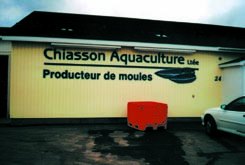
The next day as I arrived at Chiasson's operation I was struck by how clean and neat everything was. The operation's stylized name was on the building exterior and the delivery trucks.
Inside the plant, the holding, processing (declumping, grading, and debyssing), and packing areas were clean. There was also a small retail area just inside the reception area adjacent to the offices.
The point I want to make is that, in general, aquaculture operations put little effort into how they look to the public. We all know that the public perception of our industry is not entirely positive and this is one simple way to improve that image both for consumers and potential investors.
From the way his business presented itself and from talking to Yvon, it was clear he has figured out that marketing is as important or even more important than the farming operation. Yvon, a constant promoter, never missed a chance to get his company name and product out there. Visitors, for example, are given Chiasson Aquaculture caps.
Yvon showed me a poster that he has made up for retail serving counters that has all the same information as the tabletop cards. The Chiasson message is getting out to both the food service and retail sectors.
With the purchase of the new packaging machine, all the elements of Yvon's direct marketing strategy are in place. The packages will be unique with his special color of knitted net, which is very similar to real fishing net to give that fresh from the sea perception. It will have the Chiasson label that will match the information on his tabletop cards and posters. It will have his logo as well as nutritional information and suggested recipes.
Yvon agreed that his competition is not other mussel growers, but other sources of food protein. If you look around at any food market or specialty store you will see that there is big competition among pork, beef, and poultry, but not for seafood.
We've hardly begun to affect consumer consumption habits with seafood. The cultured shellfish industry needs more efforts such as Yvon's: a full service product market campaign driven by the producer from the ground up, at a minimal cost per unit.
If you do not invest in marketing yourself and your product while you are growing, you will be at the mercy of commodity market pricing down the road at harvest time.
Farm operation
On the farm operation side, Chiasson Aquaculture has been around for 15 years and, on average, employs 20 people.
Mussel growout from larvae to market size takes 1824 months. Yvon has a total of 300 hectares (750 acres) under l
ease at four different sites, with roughly a 1/2-hour sail between sites.
|
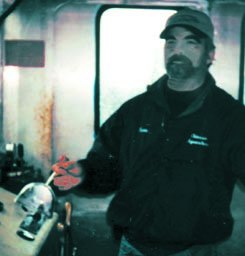
Even the clean, modern, attractive Chiasson plant helps sell a positive image to customers and passersby reinforcing the company's marketing message of top quality. At right, Yvon Chiasson, a progressive grower and shrewd marketer. |
 |
Harvesting occurs in both winter and summer months and the operation has holding facilities to service its clients needs during off-harvest time.
The farm has two work boats. One is a preparation work barge with minimum hydraulic capability. The main vessel is a specially built diesel-powered barge with lots of hydraulic power to run the work crane, star wheels, and automatic continuous socking machines. It has a stern-mounted wheelhouse and is equipped with sounder, radar, and radios.
Ninety percent of Chiasson's product is sold in the province of Quebec and the remainder is marketed in the local region. Current annual production is approximately one million pounds, with plans on track to double that volume within two years.
Yvon also plans to get back into growing oysters, a species he gave up on a number of years ago. With new husbandry technology, however, he now thinks oysters can be successfully grown.
Chiasson has not been afraid to invest in new mussel husbandry technology, either. He, like many, used to operate single-dropper sock longlines. Since continuous socking gear has become available, he has moved to that technology.
Yvon follows some very basic rules of success in his business:
- Spend money to make money;
- Invest in new technologies as soon as they are available because labor will always cost more;
- Market your product and yourself as hard as you farm mussels; and
- Deliver the quality and quantities that you claim you can.
Chiasson has one of the few mussel companies in North America that is doing it right!
Don Bishop, vice president of operations for Fukui North America, a division of Fukui Fishing Net Co. Ltd., has 20 years of technical and distribution experience. His primary responsibility is in the development and enhancement of aquaculture growout gear and systems for finfish and shellfish in both salt and fresh water applications. Comments may be addressed to Fukui North America, PO Box 119, Island View Dr., Golden Lake, Ontario, Canada K0J 1X0; call (613) 625-2544; fax (613) 625-2688; or e-mail [email protected]. .