Oyster bag grid system saves labor
A few articles back, I mentioned some work we had been doing on a floating bag system for oyster growout. This system is an example of how ideas from growers in different areas, combined with some engineering experience, can lead to husbandry method solutions that can benefit the industry as a whole.
At a show a few years ago in eastern Canada, I was approached by some oyster growers to look at the potential of developing a system that would allow Durethene® polyethylene rigid oyster bags to be connected together. The idea was to form a grid using bags with floatation to minimize labor cost.
I remembered I had seen some development of a similar concept in Maine a few years back and, together with their ideas and the pictures from Maine, the growers and I developed a concept to meet their needs.
As in any development project, we first had to set the parameters and objectives of what we wanted to do. In this case, we wanted to develop a system using equipment that was readily available and easy to assemble, that would reduce labor and handling cost per unit, and that would increase yields and improve quality of the product.
We also wanted to look at reducing the growout cycle, have a way to control biofouling, and, most important of all, we wanted to be able to work in conditions of sea or pack ice.
On top of all this, we had to make sure that the initial capital cost with respect to output production was affordable and made economic sense.
With this in mind, we set to work studying what had been done in Maine, with an understanding of equipment availability, the biological conditions, and the dynamic physical conditions of the area. We were then able to provide a protocol that we explained in a tech tip that we released in early 1998.
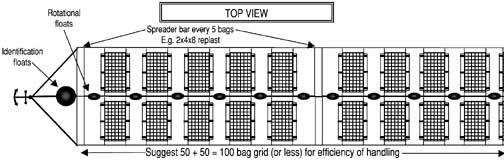
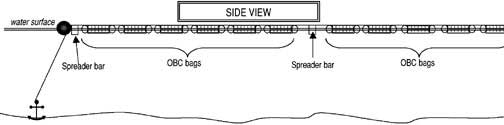
The tech tip explained the assembly of ADPI OBC rectangular mesh bags using 2"x2" building construction Styrofoam for floatation, held in place along each of the interior long sides with cable tie wraps. The bags were formed into a box to allow ease of floatation and to allow maximum product growout area within the bag.
The bags were assembled at one end with hog rings, and at the other end with special removable clips. Aluminum 4" rings (lobster trap head rings) were inserted through the mesh at either end. This allowed a way to attach each bag to a double surface longline that would allow a designated number of bags to be deployed and managed on the surface.
The double longlines were attached to anchors at each end with a spreader bar on the lines between the anchor and the first bag to keep the longlines slightly further apart than the length of the bag.
The idea of having a surface bag is based on the fact that the surface is usually the most productive part of the water column and, therefore, allows for higher growth rates. Unfortunately, it is also the area with the highest biofouling challenges.
It was found that flipping the bags at specific intervals allowed the sun and air to decompose the fouled side. Thus, this fouling control system made it possible for the growers to take advantage of the higher growth rates near the surface. As an added bonus, having the bags at the surface also allowed wave action to agitate the bags, which allowed for a partial shell shaping and beach hardening process.
Winter use
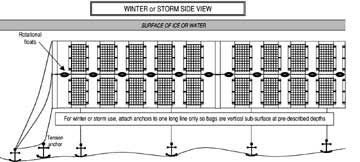
With respect to winter conditions of ice and/or high energy environments, it was found that the entire system could be submerged with the bags in a vertical position to a prescribed depth by attaching anchors with the correct length of rope to one longline only.
When we originally released our tech tip, one of the first individuals to recognize the value of the system was Maurice Daigle of Richibouctou, New Brunswick, Canada.
Maurice's early observation proved that surface growout was definitely better than the rack-on-bottom method that he had been using. In fact, his normal 10-15 millimeter (mm) per year growout advanced to 20-25 mm per year on average.
Starting with stocking densities of 1,000 seed per bag and eventually thinning down to 250 market-ready 2"-plus oysters per bag with the ability to over-winter under the ice was a breakthrough for oyster husbandry methods in this region.
However, there was a problem. As the oysters grew and the weight increased, the floatation per bag was not enough to keep the bags out of the water. In fact, in some cases, they were just subsurface, which didn't allow for fouling control. Included in this fouling was a mussel-spat set that covered the bottom and top of the subsurface bag, further increasing the weight.
In order to compensate, we would have to further increase the buoyancy. However, to do so by adding additional Styrofoam would take up so much bag space that output production would be limited.
Bouyancy fix
The solution was the development of a special high-density round Styrofoam bullet that could be mounted externally.
What this did was to allow an increase in production room as well as keep full bags far enough out of the water so that fouling and mussel set could be controlled.
While the cost of the new bullets was more than the construction foam, once you factored in the labor of cutting the foam sheets and combined that with the increased product yield and increased durability of the high-density foam, you were actually at an advantage position.
Further enhancements were made by adding a third longline off the same two anchors, which allowed a doubling of productivity with a less per bag deployment cost.
To reduce labor costs even more on the three-line system, 2"x4"x8' replast plastic wood was added to hold the line apart. Installing the replast at, say, five-bag intervals along the lines allowed for volume control of flipping using a boat-mounted crane. This worked by rotating the complete grid set up on the buoyed center line instead of flipping one bag at a time. With a grid set up of 50x2=100 bags, this provides considerable time saving compared to flipping one bag at a time.
As this system becomes more widely used and more growers become involved, their input from their experiences will, I am sure, lead to further improvements in efficiency.
For example, we have changed the hook-up of the bags from the aluminum rings to that of special hooks and shock cord under tension to enhance the shell pruning effect and further reduce labor during deployment.
The finances of the system are great in that, based on current market net price, the equipment for a 100-bag system will cost in the area of US $1,200. This will produce approximately 12,000 oysters per cycle worth a current mid-US East Coast market value of US $6,000 at US 50 cents per unit.
Even if you are at West Coast pricing of US 25 cents per unit, that is still a doubling of your invested capital in one growout cycle with equipment that should last approximately six to more than 10 years.
While this isn't as good for overall performance as the Australian type of adjustable longline system, it will suit the specifics of many sites very effectively.
Individuals are welcome to contact me if they require further information on this system at our offices.
Don Bishop, vice president of operations for Fukui North America, a division of Fishing Net Co. Ltd., has 20 years of technical and distribution experience. His primary responsibility is the development and enhancement of aquaculture growout gear and systems for finfish and shellfish in both salt and fresh water applications. Comments may be addressed to: Fukui North America, PO Box 119, Island View Dr., Golden Lake, Ontario, Canada KOJ 1XO; phone (613) 625-2544; fax (613) 625-2688; or e-mail [email protected]..
Don't miss a single issue - subscribe today !

Please contact
Fish Farming News for reprint information
and permission. - © Compass Publications, Inc.,
2000