March 2001 - Commercial Fisheries News
Electronics logbook:
Precise lobster catch records
ELLSWORTH, ME - Imagine if scientists and regulators could see what a fisherman sees when he is out fishing. That is what Thistle Marine's HMS-410 Electronic Logbook promises to the lobster industry.
Through the combination of broad onboard recording capability and customized computer software, lobstermen can create a detailed description of each day's catch. The information is stored electronically by a Thistle computer and, depending on each fisherman's preference, is available either to the harvester alone or to managers and scientists as well.
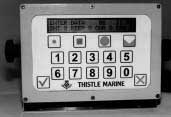 |
The Face of the HMS-410
is designed to be used by a lobsterman with gloved hands. |
The recording unit is a rugged, electronic keypad that mounts by the wheel or hauling station. It enables a fisherman, with gloved hand, to record the lobster catch from each trap not only counters but the shorts, oversize, and v-notch and eggers as well.
For the lobster industry, it is the discarded lobsters that are controversial. Maine fishermen have long asserted that they see many v-notched, oversize, and egged lobsters, but have been unable to document them scientifically.
A voluntary, once-a-year mail-in v-notch survey by the Maine Lobstermen's Association (MLA) has been the only way for fishermen to provide any numbers about the v-notch population except for state and federal sea sampling, a very labor intensive and expensive process.
|
"This machine empowers lobstermen to do more than just go to the public hearing and wave their fists," said Leroy Bridges, president of the DownEast Lobstermen's Association (DELA), who has used an electronic logbook since last May. "The feds say that there is a lack of large, egg-bearing lobsters," said Stephen Robbins III, executive director of DELA. "This HMS-410 will enable us to document what we see and get an accurate representation of our fishery." Bridges and Robbins were speaking to the Maine Legislature's Joint Standing Committee on Marine Resources in January. In fact, the Maine Department of Marine Resources (DMR) has purchased 124 units to supplement its sea sampling efforts. Forty are already installed for use by volunteer lobstermen and the others are mostly spoken for. "I am very impressed with quality and quantity of the information coming out," said Carl Wilson, the state's lobster biologist. |
|
| . . Lobsterman Leroy Bridges, who uses the electronic logbook, is convinced the catch data will validate fishermen's testimony on lobster abundance as well as improve fishing efficiency over time. |
"We do 21 sea sampling trips per month," said Wilson. "That's just three trips per zone, per month to characterize a 53-million-pound fishery."
The Maine coast is divided into seven lobster management zones.
In contrast, just two fishermen using Thistle units last summer counted more lobsters than the entire sea sampling program, Wilson explained.
"In the future, I see sea sampling being the check on this (Thistle) data rather than the other way around," Wilson said.
If a fisherman signs up with the state, DMR provides the box in exchange for the fisherman sharing his data with the DMR.
How it works
The HMS-410 is a 7"x10"x4" unit that connects to the boat's onboard power and GPS. As a lobsterman punches in the counts from a given trap, the machine automatically records the boat's position.
The unit comes with an AC/DC adapter and phone cord that plugs into a phone line. The HMS-410's built-in modem automatically dials an 800 number to download the data to a computer at Thistle Marine. The unit has memory enough so the catch info does not have to be transmitted every day.
In addition to 10 digit keys, the over-sized keypad has four buttons across the top to enter the cull: shorts, counters, oversize, and v-notch. The display also keeps a running tally of the number of traps hauled and the counters for the day.
The unit's $650 list price includes the mounting bracket, fuse and fuse holder, and all necessary cables and cords as well as a user manual.
In addition to selling the HMS recording unit, Thistle also provides a data reporting service, which costs $30 per month. The logged information is available to the fisherman either as mailed paper reports or through a private, secure account on the company's web site.
Data reports
Fishermen accessing the web site can view their data superimposed over a chart of their local waters. The image can even be color-coded based on catch rates. They can manipulate the image by zooming in and out so that they can get a detailed picture of their harvest pattern.
In addition to these charts, the data is currently available in three reports. Thistle is adding report formats as users request them. The three formats are: l Trip report: a table that shows a daily record of number of lobsters of each size, number of traps hauled, CPUE (catch per unit effort) and CPUE per SOD (set-over day);
* CPUE over time in line-chart format; and
* A graph of a type of lobster, such as v-notch or counter, that shows that catch graphed over time.
When a fisherman signs up, he signs a contract and has three choices on how to share his information:
* Private data: no sharing at all. The fisherman is the only one who sees his data.
* Anonymous data provided to responsible agencies. The data is stripped of its identity and the locations are "washed" to a zone or 10 minute square area (12 miles by 8 miles).
* Detailed sharing. Fishermen agree to let responsible agencies see their individual data. This is the level of data sharing that fishermen agree to if they use a DMR-provided HMS-410.
For many fishermen, the idea of their fishing information being anywhere besides their head, or their paper log, is quite uncomfortable, particularly given the power of charts with trap locations and catch intensity recorded.
But Thistle Marine's Rich Arnold, who developed the HMS electronic logbook, says the system is secure. Arnold, a computer scientist, previously designed equipment to regulate hospital pharmacies.
All of the data is encrypted as it is sent over the phone lines, Arnold said, and the fisherman controls who, if anyone, can view his data.
Fishermen are more concerned about sharing data with other fisherman than they are about sharing data with the state,according to Wilson. He explained that state rules require the data to be lumped with other fishermen and released in such a way as not to compromise confidentiality.
Arnold acknowledged that when he talks to lobstermen, they often say they're worried that using the unit would take too much time. But after using it since May, Bridges estimated it adds only five minutes to his day and Robbins said, "The unit registers information as fast as you can plug it in."
Bridges said, "The first day you get the machine, you should just try to get used to it, practice counting lobsters, and figure out how to adapt your routine such as dumping everything from the trap into the box and counting from there."
"Generally people are not counting things," Robbins said, "that's what takes getting used to." He said he does it in the order that the buttons are on the machine, left to right: shorts, counters, oversize, and v-notch. "Once you are in the habit of doing it, it's simple, second nature."
"Placement is critical," said Bridges. "I have mine almost touching the throttle lever. On my boat I enter the data so I control the quality of it."
The other side of the Thistle HMS-410 is that it is a powerful business tool for fishing efficiency. The reports show catch by each trap, each location, each day, and are presented both on a chart and in table formats.
"To me, this is as important as any other piece of electronics on the boat," said Bridges. "I have ulterior motives not just to supply data to DMR and NMFS, but also for myself."
Bridges said that in 10 years, instead of fumbling through notebooks, he can have an electronic archive of years that will enable him to look at where it's best to set traps in a given week.
The HMS-410 is designed to be compatible with requirements of the new Atlantic Coast Cooperative Statistics Program in the event mandatory reporting is required for lobsters.
Arnold said he hopes to develop a multispecies, mobile gear version of the electronic logbook in the next year and eventually to introduce this technology to fisheries worldwide.
For more information, call Arnold at (207) 667-8200 or check the Thistle web site www.thistlemarine.com.
DMR's Carl Wilson can be reached at (207) 633-9538. /cfn/
as printed in the March 3001 issue of Commercial Fisheries News a publication of Compass Publications, Inc.