Tilapia in the California desert |
 |
||
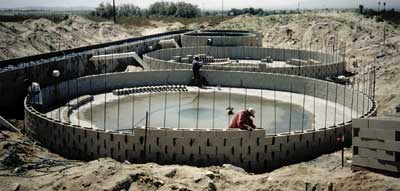
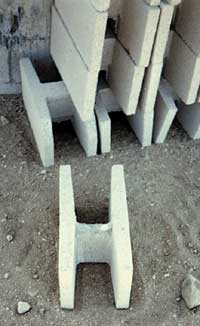
| Dean Farrell's tilapia farm in Palm Springs, CA. Below, construction of two 40' diameter tanks nears completion using H blocks, below, filled with concrete. | |||
|
For years Dean Farrell carried around a business card with his name on it, but without a company name. I am not sure if that was done so that he could create interesting conversation, or whether he was not sure if he was going to raise fish. Dean studied the recirculating aquaculture market for eight years before he invested in his current farm. Prior to this operation he had been involved with tree farming, importing lobsters, and other ventures. His current business card says: DEAN FARRELL Research and Development, an indication that though he now is a fish farmer, he sees himself as a person of learning and new ideas. You can't help but wonder if a successful fish farmer can be any other way.
One of my first experiences with Dean went something like this: Over 10 years ago I was giving a talk on oxygen in Orlando, FL. After the talk, Dean followed me into the men's room to continue his line of questioning while we both did what we came in to do. Dean is neither shy nor dumb. He is also not bashful about asking questions or sharing his ideas with anyone |
 |
||
Farm operation
The Farrell farm in Palm Springs, CA has been in operation for 4-1/2 years. Named Seagreen Bio, it annually produces 325,000 pounds of Tilapia mossambicus for the live market in Southern California.
Dean has put together a system "designed to be the lowest capital cost per pound of annual production." The KISS principle (keep it simple, stupid) has allowed him to be profitable.
Forty-foot diameter main culture tanks are constructed of concrete with H block used for the sides and a poured bottom. The double open-ended H block is stacked up to a height of 7' (6' of water), and cement is pumped in the openings for structural stability.
The farm takes advantage of the abundant, good geothermal water supply that is typical of this area of the California desert. Well water arrives at the surface at 84° F. A temperature of 75°-84° is maintained in all culture tanks. 62% of the water is exchanged every 20 hours.
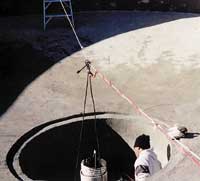 |
Each tank bottom includes a 5' deep sump with the recirculating water inflow and an outflow where collected solids are gravity fed by pipe to a retention pond. |
|
The water system design relies on one pump. Dean quotes fellow tilapia producer Dick Pratt from Arkansas: "One god, one country, one pump." Water is recirculated throughout the entire facility by this one pump or gravity. An 8' diameter by 5' deep sump is built into the bottom of each tank, incorporating two drains. A screen rests on top of the sump opening to keep out fish. Two pipes move water from each tank. A pipe installed roughly one-third the way down recirculates water through the system. |
|
| Harvesting using homemade graders built from 3/4" PVC pipe. | 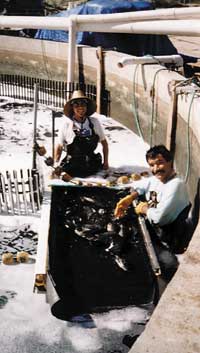 |
A second pipe on the bottom of the sump is called the entry to the "poop shoot" and removes settled feces. This waste gravity feeds into a retention pond. The water from the pond is used for irrigation on Dean's property.
Site conditions
Dean calls his biofilter a "single cell protein reactor" with suspended, ammonia-consuming bacteria throughout the water column. 75% of the oxygen added to the water is used to support these bacteria and the fish use only 25%. Re-oxygenated water is introduced into the tank on the bottom to assist in causing a circular flow to the center for feces accumulation. By design, no tank can be completely dewatered without employing an additional pump.
Oxygen is maintained at saturation or better by using a counter-current 40' deep U-tube type device at the well. Dean has determined that oxygen is introduced into this pipe as a gas with a bubble size of roughly 2 mm and has an 80-130 second hangtime. Gas is dissolved by following the laws of partial pressure, which simply means a gas will dissolve easier when it is under pressure. The system is designed to be 70%-75% efficient.
Total ammonia levels of 15-18 ppm have not been uncommon with no apparent side effects. Maintaining a carbon dioxide level of 40-50 ppm controls the un-ionized portion of ammonia. Excess carbon dioxide is vented off in the return water. The higher carbon dioxide level lowers the pH from 7.8 down to about 6.5, which reduces the toxicity of the un-ionized portion of the total ammonia. Alkalinity is kept at roughly 90 ppm.
Feeding practices
Dean hatches his own fish. The fish are fed sex reversal feed for 20 days to produce faster growing males. Small fish are fed #00 or #1 starter.
Tanks are stocked with variable sized fish from 20 grams to 600 grams. A 35% protein floating feed purchased in bulk in 1/8" size only is used. Fish are fed six times daily. They are fed what they will consume within 25 minute of feeding by hand. An average feed conversion for the entire farm has been determined to be roughly 2 to 1.
It takes roughly one year from egg to the target harvest weight of 600 grams. Tilapia mossambicus have what Dean called a "social pecking order." They are called alpha, beta, and gamma fish. Each fish type represents roughly one-third of the population in any given tank.
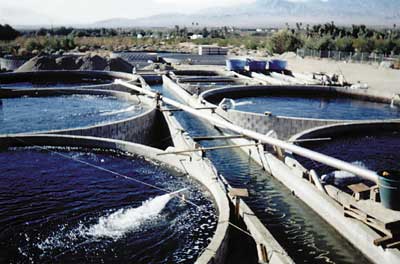 |
At left, an 8" aluminum irrigation pipe is used in conjunction with a large flower pot (extreme lower right of photo) to move fish from tank to tank. Recirculating water coming into each tank creates a circular flow toward the center sump, seen at lower left. |
The alpha fish can grow to 600 grams in roughly 8 months. They have a feed conversion ratio of roughly 1.5 to 1. The beta fish take slightly longer to reach 600 grams and have a feed conversion ratio of just under 2 to 1.
The gamma fish, when combined with the other fish, do not do as well. Their feed conversion is roughly just under 3 to 1. These gamma fish seem to eat well, but they are stressed and most of the feed they digest goes into basic metabolism and not for growth. When the alpha and beta fish are removed from the tank, the gamma fish are less stressed and convert feed much better.
At harvest the fish are stocked at roughly one-half pound per gallon of water. As stated earlier, mossambicus feed conversion on the Farrell farm has averaged 2 to 1. Tilapia niloticus can average a feed conversion of 1.5 to 1 or better on certain farms. An obvious question for Dean is why isn't he raising niloticus.
His answer: No niloticus or aurea are allowed in California. The state only permits the culture of mossambicus and hornomum because they are already loose in irrigation canals, having been introduced for weed and algae control.
Harvest and grading are accomplished by using homemade graders made of 3/4" PVC pipe and 1/2" pipe as spacers. Spacing of 1", 1-3/16", 1-3/8", and 1-5/8" is used.
The graders are made in 15-foot flexible sections. Multiple sections are attached as needed when grading and harvesting.
Fish that are moved from tank to tank are lifted by a backhoe into a large tub (actually a flowerpot). The pot is then attached to 20' lengths of 8" diameter aluminum irrigation pipe. When multiple 20' lengths are required the pipe connects via camlock fittings. Water is pumped into the tub and the fish flow with the water.
When asked what was his biggest challenge, Dean volunteered without hesitation: "Finding good people who are willing to work and will stay."
If he did the design over again he would increase all pipe sizes to minimize head loss or fouling problems.
Contact Dean at Seagreen Associates, Box 1564 Palm Springs, CA 92262; or phone (760) 251-7391.
He'd love to talk about fish!
Bob Robinson is a fisheries biologist with Kasco Marine Inc. He can be reached at <[email protected]>.
